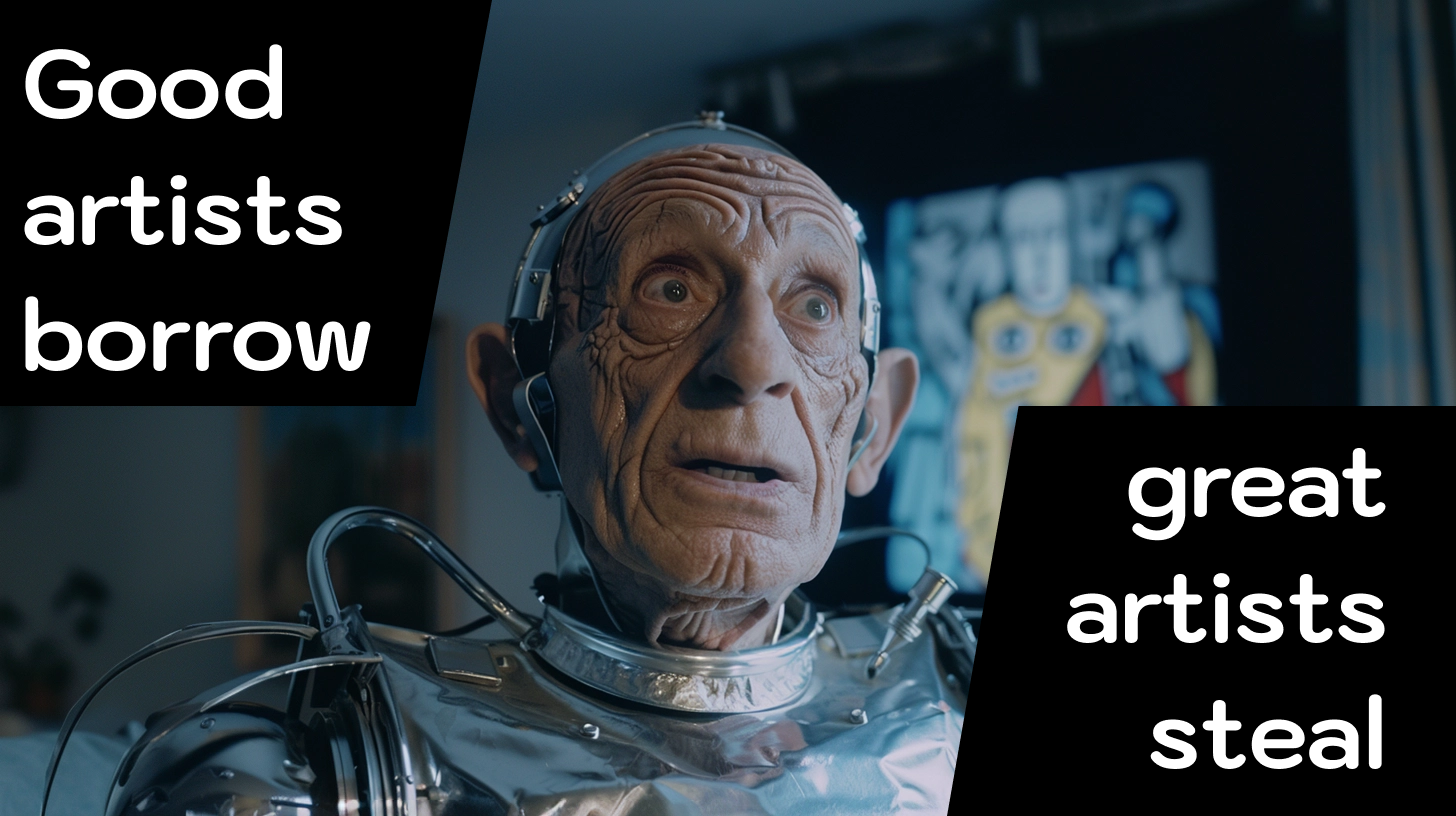
<?xml version="1.0" encoding="utf-8"?><feed xmlns="http://www.w3.org/2005/Atom" ><generator uri="https://jekyllrb.com/" version="4.4.1">Jekyll</generator><link href="https://art.digiguru.co.uk/feed.xml" rel="self" type="application/atom+xml" /><link href="https://art.digiguru.co.uk/" rel="alternate" type="text/html" /><updated>2026-08-17T07:56:42+00:00</updated><id>https://art.digiguru.co.uk/feed.xml</id><title type="html">Digiguru.co.uk</title><subtitle>AI, technology, creativity and personal growth articles, experiments and presentations from Adam Hall.</subtitle><entry><title type="html">The Great Art Heist: AI Edition</title><link href="https://art.digiguru.co.uk/blog/2024/03/27/the-great-art-heist.html" rel="alternate" type="text/html" title="The Great Art Heist: AI Edition" /><published>2024-03-27T22:00:00+00:00</published><updated>2024-03-27T22:00:00+00:00</updated><id>https://art.digiguru.co.uk/blog/2024/03/27/the-great-art-heist</id><content type="html" xml:base="https://art.digiguru.co.uk/blog/2024/03/27/the-great-art-heist.html"><![CDATA[<p>Picasso said, ‘Great artists steal.’ AI took this idea and turned it into a cultural revolution.</p>

<p><img src="/assets/picasso-quote.png" alt="Picasso as a robot saying &quot;Good artists borrow, great artists steal&quot;" /></p>

<p>AI Art is trained on vast datasets of existing images. These images are transformed into numerical representations by machine learning. From this, AI generates new pieces of art, influenced by all imagery it’s been trained on, but filtered to the words provided in a prompt.
<!--break--></p>

<p>This dataset likely emerged from images online. We don’t know for sure what has gone into train the machine, but try typing in “film still, THE AVENGERS (2012)” into midjourney to see it’s power at pixels in a very familiar style.</p>

<p>Many are unsettled by this dataset, labelling it theft.</p>

<h2 id="a-tale-as-old-as-time">A Tale as Old as Time</h2>

<p>But this is precisely how human artists created art before ever existed.</p>

<p>Through a process called “inspiration” artists would absorb everything they saw, from a beautiful landscape or a crudely scrawled graffiti in a toilet cubicle through their optical nerve. This would then be processed by the posterior parietal cortex and eventually represented in the fronto-parietal network, available to be called on whenever inspiration was required.</p>

<p>It is true that AI Artists often find themselves becoming more aware of art styles, artists and aesthetics as they progress as an AI artist.</p>

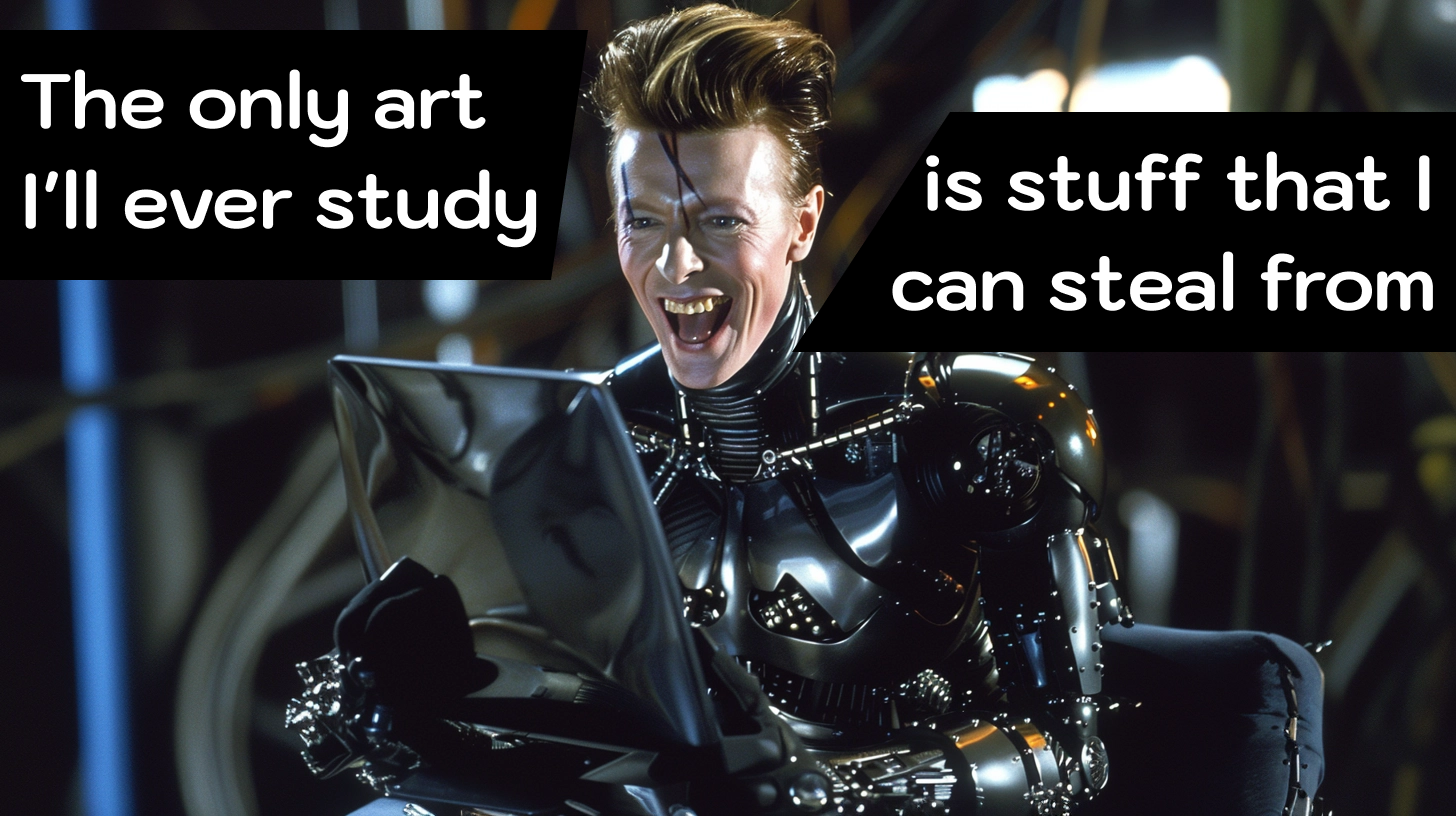
<p><img src="/assets/bowie-quote.png" alt="David Bowie as a robot saying &quot;The only art I'll ever study is stuff that I can steal from.&quot;" /></p>

<blockquote>
  <p>“The only art I’ll ever study is stuff that I can steal from.” - David Bowie</p>
</blockquote>

<h2 id="the-desire-to-be-seen">The Desire to be Seen</h2>

<p>The datasets powering many art services consist of seemingly stolen imagery. This is because in the early days of the internet people put some simple commands on their websites.</p>

<div class="language-plaintext highlighter-rouge"><div class="highlight"><pre class="highlight"><code>ʀᴏʙᴏᴛꜱ.ᴛxᴛ

ᴜꜱᴇʀ-ᴀɢᴇɴᴛ: *
ᴀʟʟᴏᴡ: /
</code></pre></div></div>

<p>This simple command invited search engines like Google to crawl their sites and allow them to be seen in search engine results.</p>

<p>Unwittingly they were asking for their work to be crawled by robots.</p>

<p>These robots fed the datasets.</p>

<p>These datasets were used to train AI.</p>

<h2 id="the-irony-of-ai-artists">The Irony of AI Artists</h2>

<p>Yet, on 𝕏 I often see AI artists often complain about their work being remixed. They lament over their prompts being ‘stolen.’ The irony is thick.</p>

<p>This is because people yearn to be the great discoverer. The original. The creator.</p>

<p>But these people miss the point.</p>

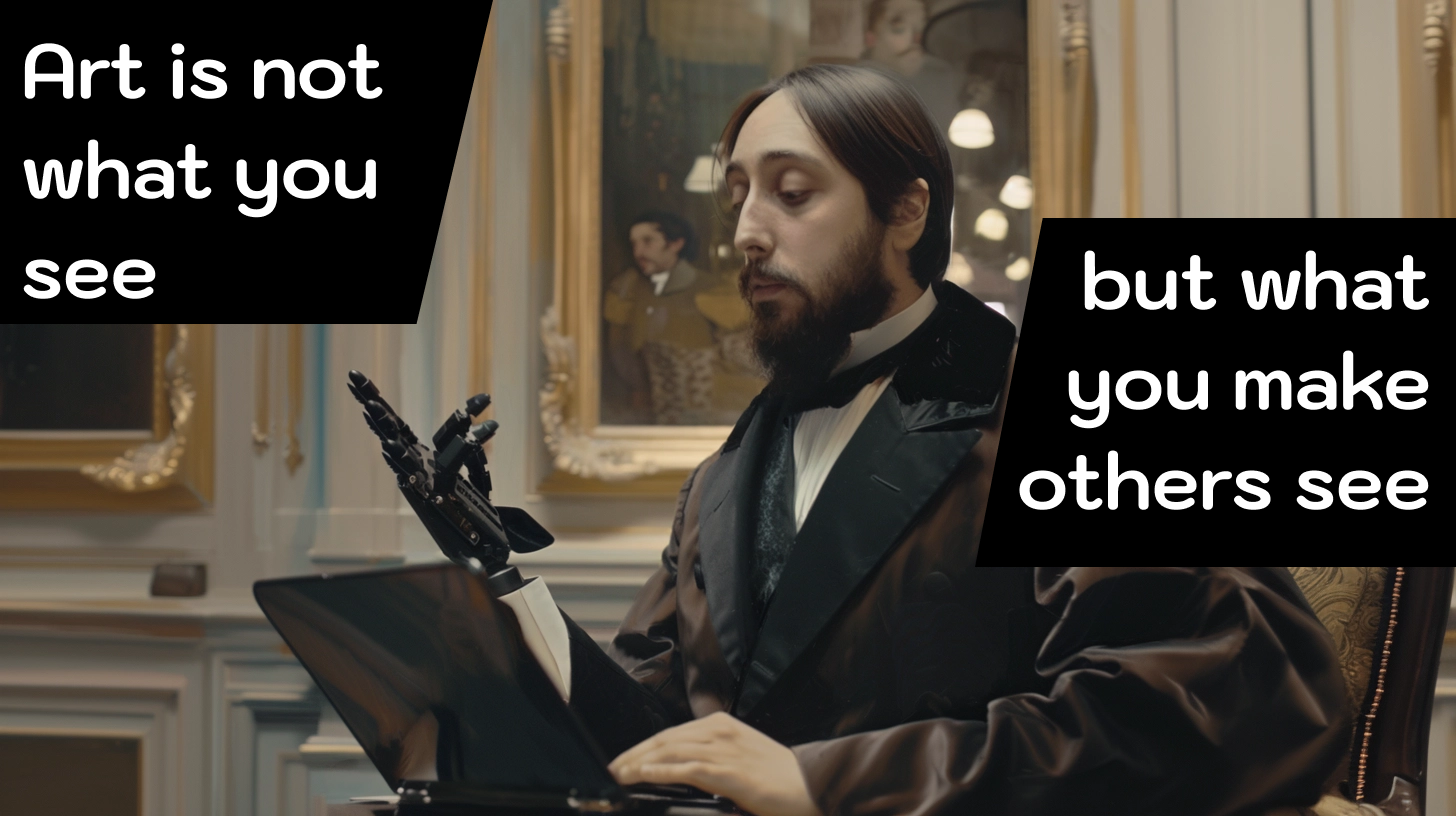
<p><img src="/assets/degas-quote.png" alt="Edgar Degas as a robot saying &quot;Art is not what you see, but what you make others see.&quot;" /></p>

<blockquote>
  <p>“Art is not what you see, but what you make others see.” - Edgar Degas</p>
</blockquote>

<p>The true purpose of AI Art is to continue the discourse of creativity. To inspire others and help them remix your work as they make sense of the world.</p>

<p>You have a choice when you see art you create being stolen.</p>

<p>You can be frustrated - which leads to resentment and pain.</p>

<p>You can be inspired - which leads to new ideas and understanding.</p>

<p>Art has always thrived on influence. AI’s approach is merely more instant.</p>

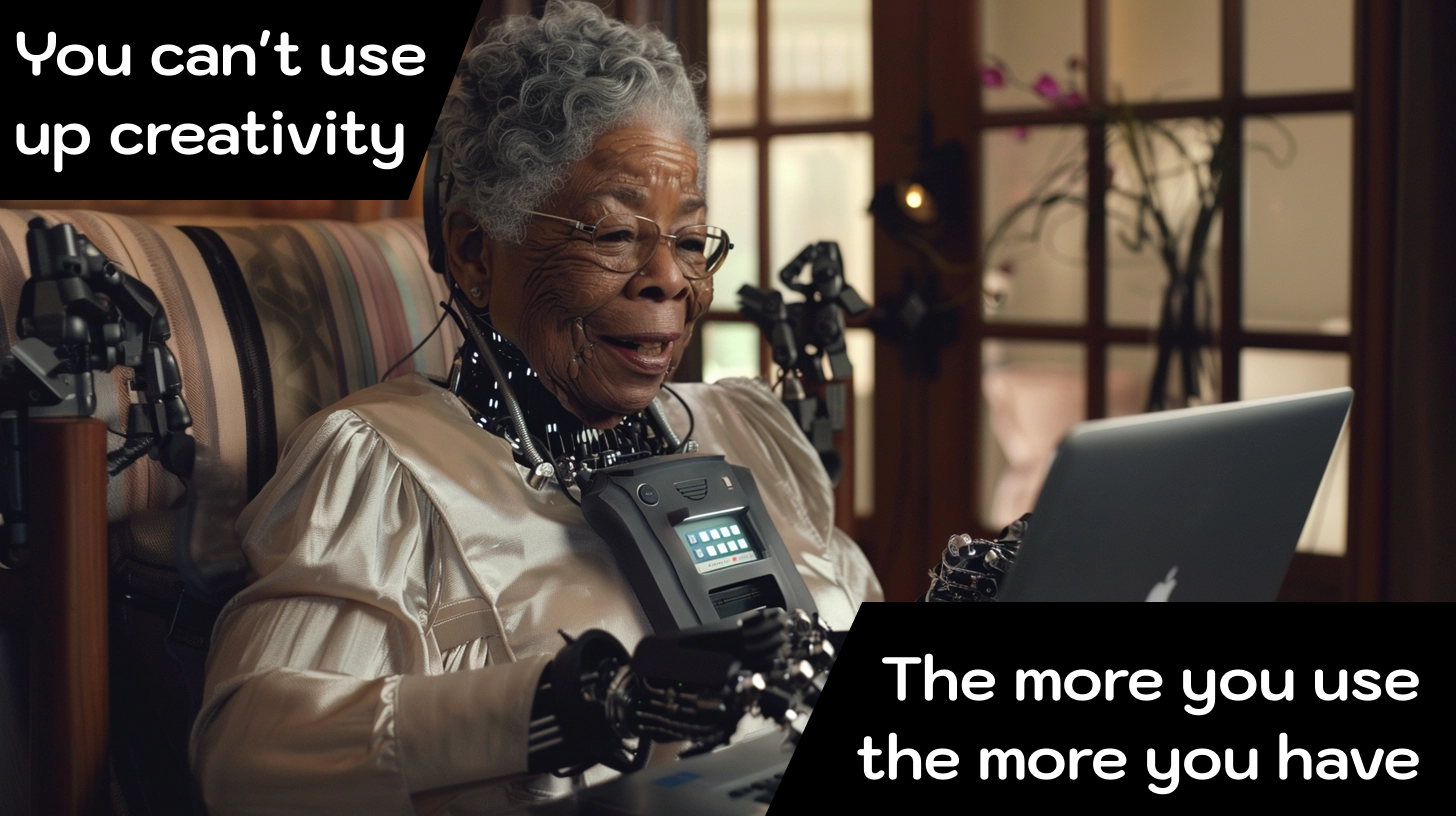
<p>To those who are feeling frustrated from stolen work, I offer Maya Angelou’s wisdom:</p>

<p><img src="/assets/angelou-quote.png" alt=" Maya Angelou as a robot saying &quot;You can't use up creativity. The more you use, the more you have.&quot;" /></p>

<blockquote>
  <p>“You can’t use up creativity. The more you use, the more you have.”</p>
</blockquote>

<h2 id="conclusion-the-future-is-borrowed">Conclusion: The Future is Borrowed:</h2>

<p>AI art intertwines the influence of the many into something personal and new. As we embrace this digital renaissance, let’s share ideas freely.</p>

<p>After all, creativity should never be taken too seriously.</p>]]></content><author><name></name></author><category term="blog" /><category term="AI" /><category term="art" /><category term="theft" /><summary type="html"><![CDATA[Picasso said, ‘Great artists steal.’ AI took this idea and turned it into a cultural revolution.]]></summary></entry><entry><title type="html">Is your organisation more productive as a result of GenAI?</title><link href="https://art.digiguru.co.uk/blog/2023/12/01/genai-productivity.html" rel="alternate" type="text/html" title="Is your organisation more productive as a result of GenAI?" /><published>2023-12-01T22:00:00+00:00</published><updated>2023-12-01T22:00:00+00:00</updated><id>https://art.digiguru.co.uk/blog/2023/12/01/genai-productivity</id><content type="html" xml:base="https://art.digiguru.co.uk/blog/2023/12/01/genai-productivity.html"><![CDATA[<p>The world’s most powerful autocomplete service powered by AI - ChatGPT - celebrated its first birthday on 30 November 2023.</p>

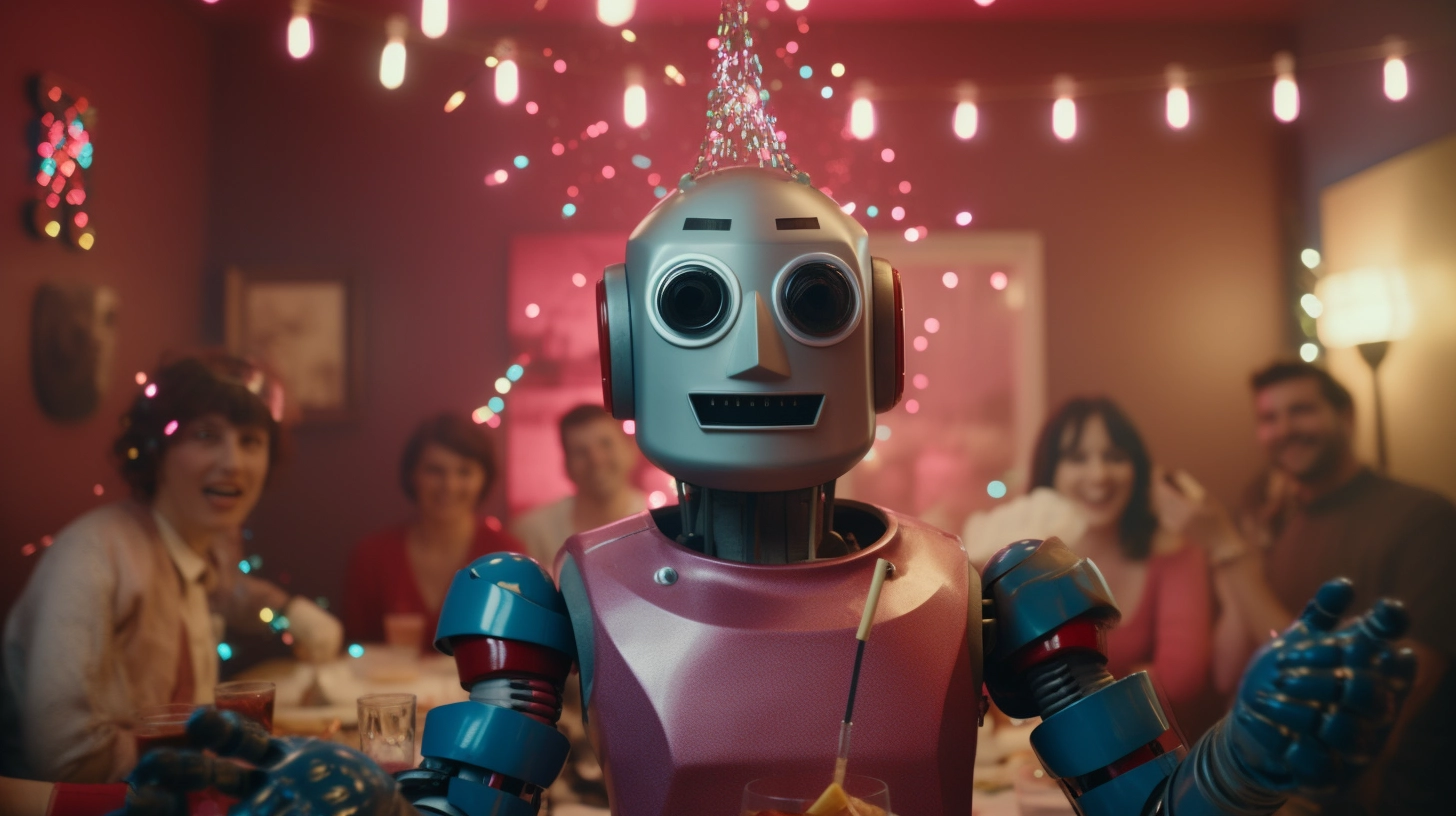
<p><img src="/assets/genai-productivity.webp" alt="A robot celebrating his first birthday" /></p>

<p>In the year since launch, ChatGPT has given people access to the remarkably lifelike outputs of the generalist knowledge and assemblage of words based on the connections in its unique and massive dataset.
<!--break--></p>

<p>With it came the doomsayers who claimed that AI tools were going to replace jobs in our organisations. Research by OpenAI from March predicted that up to 49% of workers would see half or more of their tasks exposed to LLMs (large language models) like ChatGPT. Further research conducted by Hui (et al) shows that there has been a sharp decrease in freelance jobs (and freelancers’ earnings) since ChatGPT launched in November 2022.</p>

<p>However, I have also engaged with many business leaders who can point to moments where they have felt productive using ChatGPT, but can’t see much in terms of effectiveness across the organisation.</p>

<p>In this blog, we’ll explore the impacts of ChatGPT and other large language models (LLMs) on team and individual productivity, giving you some key factors to bear in mind when trying to answer the elusive question - “Are we more productive as a result of using Generative AI?”</p>

<h2 id="driving-productivity-gains-through-generative-ai-4-factors-to-consider">Driving productivity gains through Generative AI: 4 factors to consider</h2>

<h3 id="1-before-you-start-trying-to-determine-productivity-begin-with-organisational-purpose">1. Before you start trying to determine productivity, begin with organisational purpose</h3>

<p>The purpose of most organisations isn’t to generate text. Normally it’s to solve a customer problem, convince the customer that you have solved the problem, and then persuade them to part with their money so that they can benefit from the solved problem.</p>

<p>Or, as Peter Drucker said,</p>
<blockquote>
  <p>The purpose of a business is to create a customer.</p>
</blockquote>

<p>Unless that problem is generating text (possibly based on a prompt), you’ll be unlikely to see a direct effect from the use of ChatGPT on your organisational efficiency. Even if you did, what is stopping the customer from writing their own prompt and solving the problem themselves?</p>

<h3 id="2-true-productivity-is-all-about-collaboration">2. True productivity is all about collaboration</h3>

<p>To execute on your company’s purpose you need smart people working together towards a shared goal. Some of them even create text in pursuit of that goal. Take, for example, your software development function. Is the purpose of your software developers to type code as quickly as possible?</p>

<p>No.</p>

<p>Your software developers are trying to translate your user needs into software-powered solutions. Typing is the very last piece of this puzzle. First, they need to understand the problem to solve and prioritise the minimum effort to solve it. They need to agree on a solution that is not only safe and free from causing additional problems but also adaptable for future modifications.</p>

<blockquote>
  <p>They need to collaborate.</p>
</blockquote>

<p>Then they need to write some of that knowledge in the form of code and ensure that it does what they say it does.</p>

<h3 id="3-experimenting-with-code-generation-and-optimisation-is-key">3. Experimenting with code generation and optimisation is key</h3>

<p>We’ve worked with companies and conducted research with code optimisation and generation tools to see if it makes developers more productive. The results show that it does indeed shorten the time it takes to deliver a solution. In one particular study, we identified a mobile application that was built in a legacy technology. We measured the time it took for a team to rebuild the application in a new and supported technology and compared this to another team who built the same feature set with the support of GenAI tools.</p>

<blockquote>
  <p>We found that the development team was able to deliver 25% faster using GenAI tools.</p>
</blockquote>

<p>This is, of course, subject to the software development factors for this particular research. It’s also true that software design and writing clean code in a specific paradigm/language is a skill. Few AI models will have been trained with high-quality software, especially as much of it is often closed source, yet the pool of available open-source material is so vast that finding good quality source code (from which the AI can learn) is like looking for a really small needle in a particularly enormous haystack. There remains a risk currently that injudicious use of LLMs to generate code can represent dated common practice rather than cutting edge insight.</p>

<p>Despite this, however, our experiment showed a clear effect: when you are delivering software based on a baseline and measuring it, productivity gains are there to be had.</p>

<p>Yet companies rarely have the opportunity to time a rewrite, nor can they apply the data in a manipulated way. What they instead see is “development took three sprints” rather than “development took four sprints”, or “we can deliver the same scope with only 75% of the team”. It’s hard to spot the difference when the timescale is so large. To truly see the effect of GenAI tools in your own teams you must introduce the tools and measure your new baseline (together with the quality of the code written and the documentation generated) over a period of time. Then you can see the real productivity gain your teams can achieve from GenAI tools.</p>

<h3 id="4-the-real-work-is-in-prioritising-which-problems-to-solve">4. The real work is in prioritising which problems to solve</h3>

<p>In mature software development teams, the real key is to have a continuous delivery experience where they deliver the most valuable piece of work possible to the user as quickly as possible (i.e. flow). Obviously this requires some code to achieve it but the hardest piece of the process is understanding the right problem to solve and how the team can best solve it.</p>

<p>Generative AI tools might solve some rudimentary problems in this space, but the most important qualities are the way the team can collaborate best, and the specialist domain knowledge they have accrued so far in the pursuit of that goal. Neither of these are problems suited to generative AI.</p>

<h2 id="conclusion-generative-ai-is-just-a-tool">Conclusion: Generative AI is just a tool</h2>

<p>Generative AI solves hundreds of tiny problems, but it doesn’t do the work in organisations. It’s just a tool. What it can do, however, is accelerate speed to value, one of the key factors we see of successful generative AI adoption (alongside improving the human experience and adopting an innovation mindset), and an essential capability for any organisation seeking to achieve digital greatness.</p>

<p>GenAI can help people complete text-based work a little faster, freeing them to focus more on the way they collaborate and less on the amount they type. Happy birthday autocomplete 2.0.</p>]]></content><author><name></name></author><category term="blog" /><category term="AI" /><category term="productivity" /><category term="business" /><summary type="html"><![CDATA[The world’s most powerful autocomplete service powered by AI - ChatGPT - celebrated its first birthday on 30 November 2023.]]></summary></entry><entry><title type="html">Humans are bias against AI Art</title><link href="https://art.digiguru.co.uk/blog/2023/11/05/humans-are-bias-against-ai-art.html" rel="alternate" type="text/html" title="Humans are bias against AI Art" /><published>2023-11-05T22:00:00+00:00</published><updated>2023-11-05T22:00:00+00:00</updated><id>https://art.digiguru.co.uk/blog/2023/11/05/humans-are-bias-against-ai-art</id><content type="html" xml:base="https://art.digiguru.co.uk/blog/2023/11/05/humans-are-bias-against-ai-art.html"><![CDATA[<p>Humans are bias against AI art, and that’s been scientifically proven.</p>

<p><img src="/assets/ai-bias-1.jpg" alt="A robot troubled robot in an art gallery" /></p>

<p>In a study this year called “Bias against AI art can enhance perceptions of human creativity.” 2,965 participants were shown a mix of AI art and non AI art. They were asked to rate them across a number of dimensions …
<!--break--></p>

<ul>
  <li>Liking</li>
  <li>Skill</li>
  <li>Colour</li>
  <li>Inspiration</li>
  <li>Brightness</li>
  <li>Complexity</li>
  <li>Emotional Evocation</li>
  <li>Expense</li>
</ul>

<p>(the last being whether they thought the image looked expensive)</p>

<p><img src="/assets/ai-bias-2.jpg" alt="A happy robot in an art gallery, it's raining coins" /></p>

<p>The scientists discovered that on all the dimensions art labelled as “AI” scored lower to participants than art labelled as “human”.</p>

<p>This was true whether or not the source was correctly labelled</p>

<p>This proves that humans are bias against AI. It was most notable in monetary value and perceived skill.</p>

<p><img src="/assets/ai-bias-3.jpg" alt="A robot covered in wires on a pedestal in an art gallery" /></p>

<p>Interestingly more than 70% of participants indicated they could not differentiate between AI-made and human-made images without the labels.</p>

<p>They also found that technically minded people were just as bias as other participants.</p>

<p>Many other studies have taken these findings and replicated them in similar ways.</p>

<p><img src="/assets/ai-bias-4.jpg" alt="A robot in shades holding champagne flutes in an art gallery" /></p>

<p>I am unashamedly an AI artist, but I haven’t included the #aiart hashtag in a number of months. Since then I’ve also seen an increase in engagement.  I wonder if the two are related? Do you also find that not labeling your work as AI helps with your reach?</p>

<p>Source: Horton Jr, C.B., White, M.W. &amp; Iyengar, S.S.
“Bias against AI art can enhance perceptions of human creativity. “
Sci Rep 13, 19001 (2023)</p>]]></content><author><name></name></author><category term="blog" /><category term="AIArt" /><category term="society" /><category term="bias" /><summary type="html"><![CDATA[Humans are bias against AI art, and that’s been scientifically proven.]]></summary></entry><entry><title type="html">Why AI Art haters are right</title><link href="https://art.digiguru.co.uk/blog/2023/08/29/anti-ai.html" rel="alternate" type="text/html" title="Why AI Art haters are right" /><published>2023-08-29T22:00:00+00:00</published><updated>2023-08-29T22:00:00+00:00</updated><id>https://art.digiguru.co.uk/blog/2023/08/29/anti-ai</id><content type="html" xml:base="https://art.digiguru.co.uk/blog/2023/08/29/anti-ai.html"><![CDATA[<p>Ever been trolled by AI-art haters?</p>

<p>I have.</p>

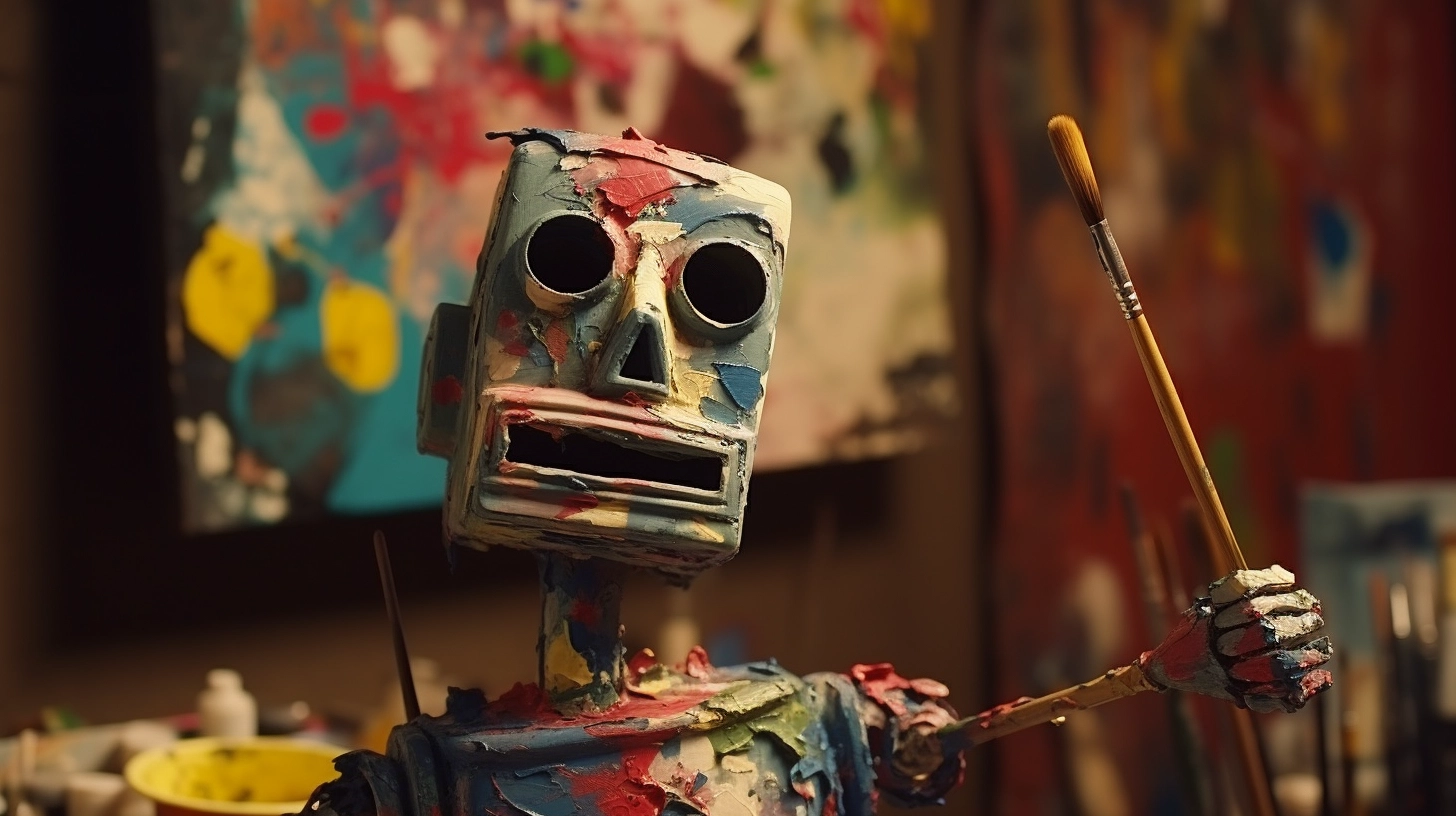
<p><img src="/assets/anti-ai-art-1.png" alt="A robot covered in paint holding a paintbrush" /></p>

<p>But then I stumbled upon a truth that transformed how I see art and deal with critics. That truth?
<!--break--></p>

<p><em>They’re right.</em></p>

<p>Before you dismiss this, let me explain. In this piece, you’ll discover:</p>

<p>Why even the harshest critics have a point
A crash course on the essence of art
Fresh perspectives to enrich your own creative journey</p>

<p>But first, why should you listen to me?</p>

<h2 id="science--art">Science &amp; Art</h2>

<p>My journey with AI Art began at the cusp of the new millennium in 1999. I enrolled in “Medilab Arts” at Plymouth University - a unique program that elegantly bridged art and science.</p>

<p>And it wasn’t just theoretical; I worked on a generative AI story writer for my final project.</p>

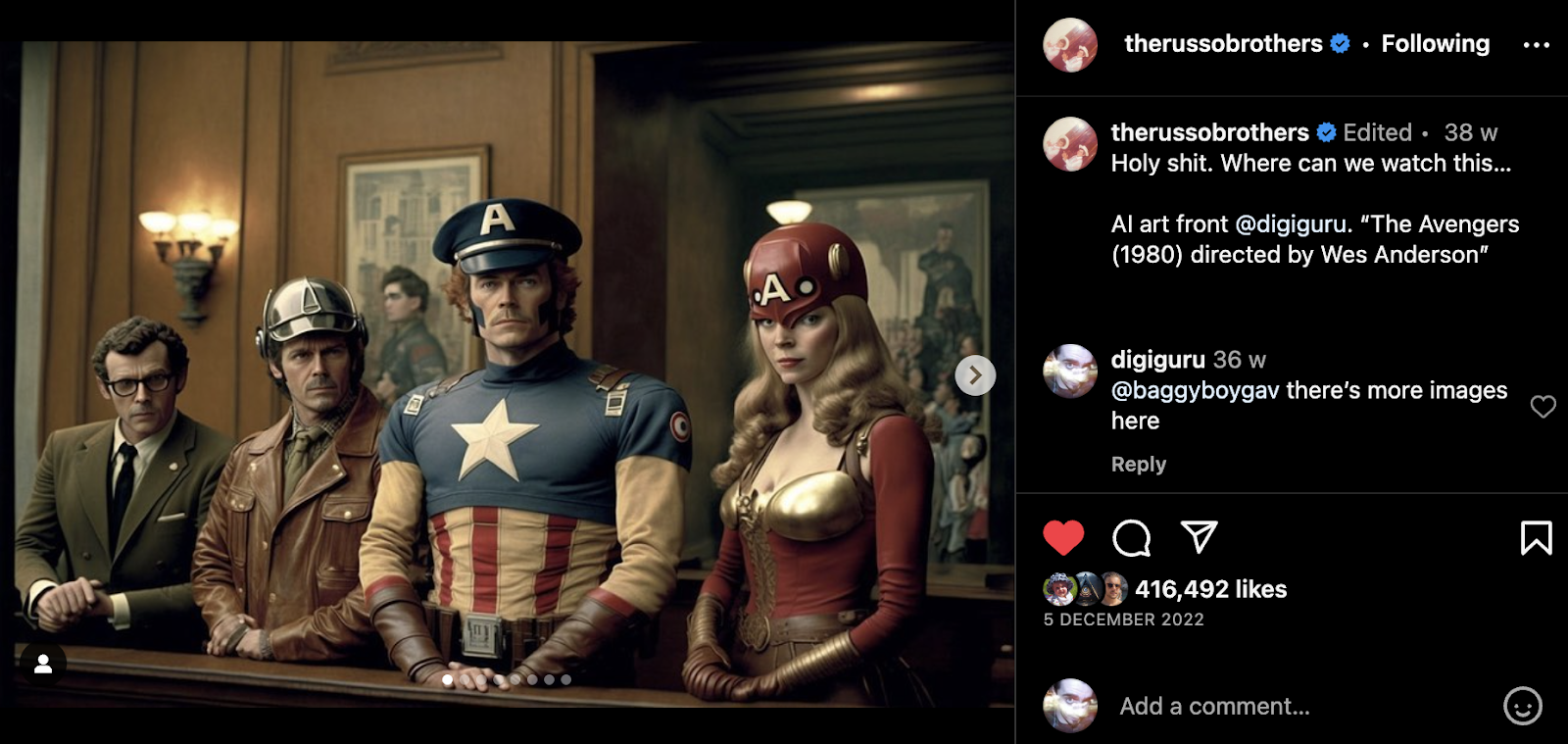
<p>However the highlight of my AI Art journey came in 2022, when a series of outputs I prompted with Midjourney went viral, amassing almost half a million likes in an hour on Instagram (thanks to the Russo Brothers sharing a tweet I made).</p>

<p><img src="/assets/anti-ai-art-2.png" alt="AI image of a 1970s Wes Anderson take on Teh Avenger's. There are too many fingers on the superheros" /></p>

<p>While the rush of recognition was exhilarating, it also unveiled the unexpected: a vehemently vocal faction of anti-AI-art critics</p>

<p>So I understand art and have experience in this new wave of AI Art, and the arguments against it.</p>

<p>And (as I’ve told you) I think Anti-AI Artists are right</p>

<h2 id="how-can-this-be">How can this be?</h2>

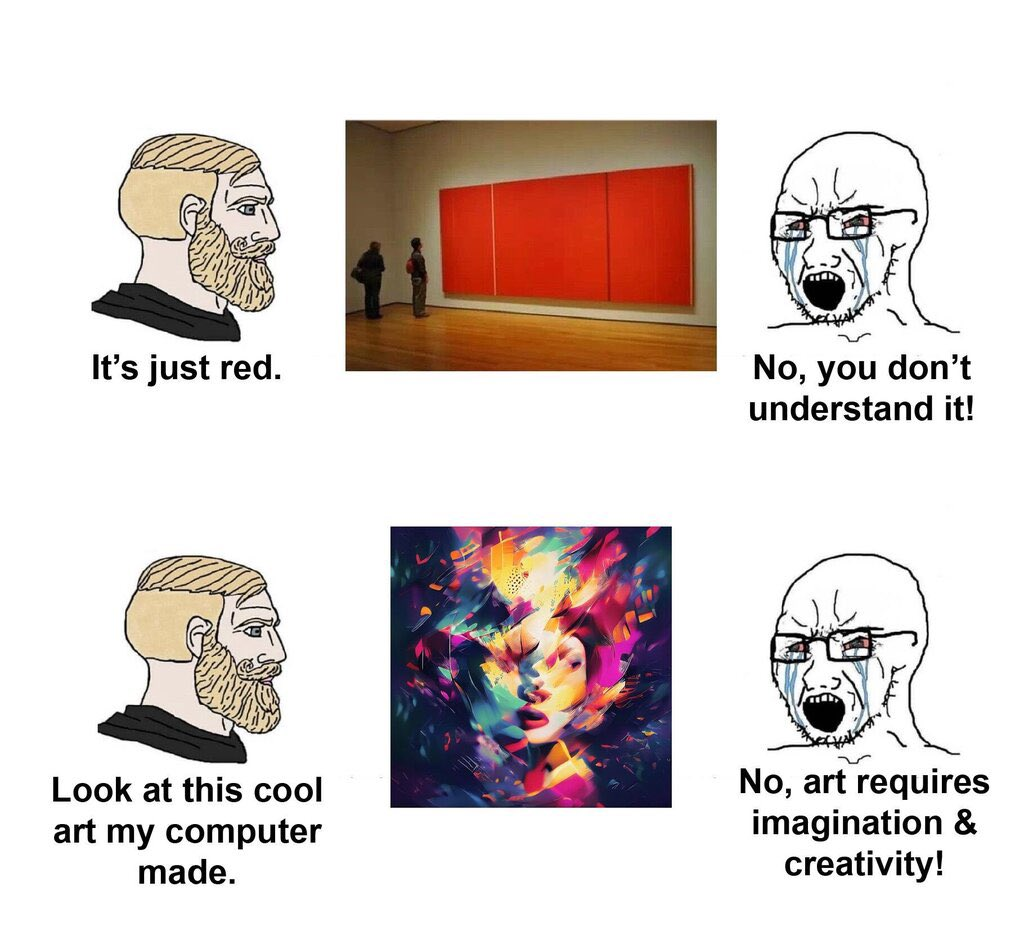
<p>It’s because Art means different things to different people</p>

<p><img src="/assets/anti-ai-art-3.png" alt="Meme of a hipster looking at a red wall. &quot;It's just red&quot; he says. Grumpy chracter says &quot;No, you don't understand it!&quot;. Then hipster is showing an abstract rendition of a lady using lots of colours &quot;Look at this cool art my computer made.&quot; Grumpy guy says &quot;No, art requires imagination and creativity!&quot;" /></p>

<p>For some people, AI Art is not art.</p>

<p>And for others, myself included, AI Art is art.</p>

<p>But these factions don’t agree on what art actually is, so let me break it down for you</p>

<h2 id="what-art-is">What art is</h2>

<p>There are 3 characteristics of art, and the appreciation of them is different for every person.</p>

<p>The 3 characteristics are…
Aesthetic - Does it look good?
Effort - Does it look like they tried?
Meaning - Does it build on something for the observer?</p>

<p>Let me give you examples of each of these.</p>

<p>Aesthetic
For some people, aesthetics are the only important thing in Art. Does the piece look good?</p>

<p>And for a large number of AI Artists that is the case. “What does it matter if a computer drew this or a human, the piece is really beautiful?”</p>

<p>And I guess one of the problems with this statement is…</p>

<h2 id="beauty-is-in-the-eye-of-the-beholder">Beauty is in the eye of the beholder.</h2>

<p>Remember when people were up in arms when “Space Opera Theater’’ by Jason Allen won an art competition back in September? This is because it was judged on aesthetics.</p>

<p><img src="/assets/anti-ai-art-4.png" alt="Space Opera Theatre by Jan Allen" /></p>

<p>You may have seen these arguments thrown at your own work, with a terse simple one word comment…</p>

<blockquote>
  <p>HANDS</p>
</blockquote>

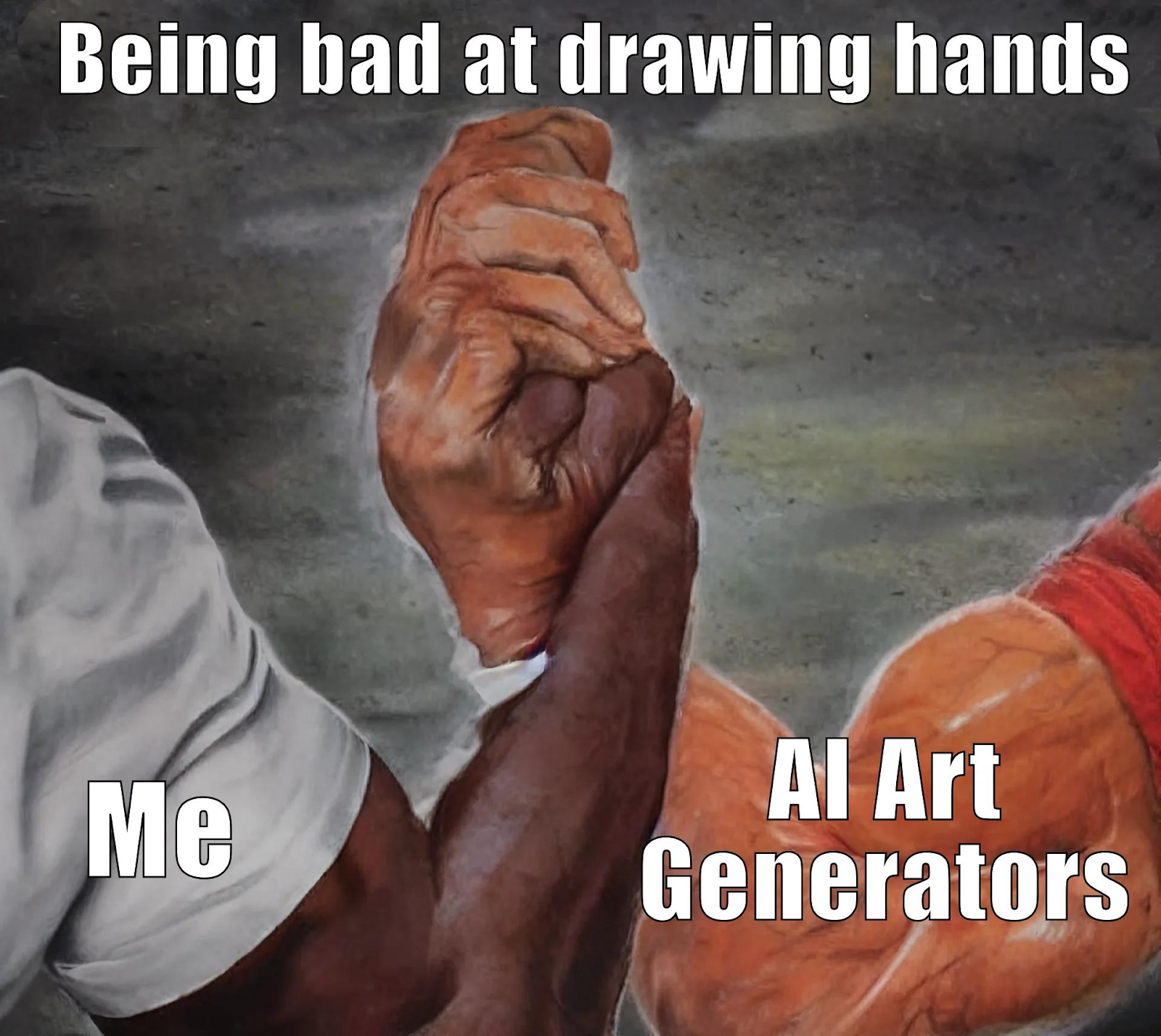
<p><img src="/assets/anti-ai-art-5.png" alt="Epic handshake meme. On the left is &quot;me&quot;. On the right is &quot;AI Art Generators&quot;. In the middle above the handshake is &quot;Being bad at drawing hands&quot;. The hands have far too many fingers." /></p>

<p>Thanks to advancements from platforms like Midjourney, such criticisms are fading. But for amusement’s sake, explore #aihandsociety to see AI’s amusing hand-drawing hiccups.</p>

<p>I know the quality of aesthetic to be true personally. In December I was once invited to display my pieces at a Parisian Art Gallery until the curator heard the pieces were made using AI. They were aesthetically pleasing and meaningful but they violated another quality…</p>

<p>The second quality of art….</p>

<h2 id="effort">Effort</h2>

<p>When we perceive effort in art, we resonate with the dedication poured into it. The Pyramids of Giza aren’t aesthetic marvels, but their grandeur inspire awe.</p>

<p>Consider 2018’s audacious art event: @elonmusk’s launch of a rocket into space only to have it reveal a spacesuit driving a Tesla playing Bowie’s “Starman” whilst saying “don’t panic” in large friendly letters on its display. This spectacle, infused with cultural nods, demonstrates effort transcending the conventional.</p>

<p><img src="/assets/anti-ai-art-6.png" alt="Photograph of a Tesla being driven by a SpaceX spacesuit above planet earth" /></p>

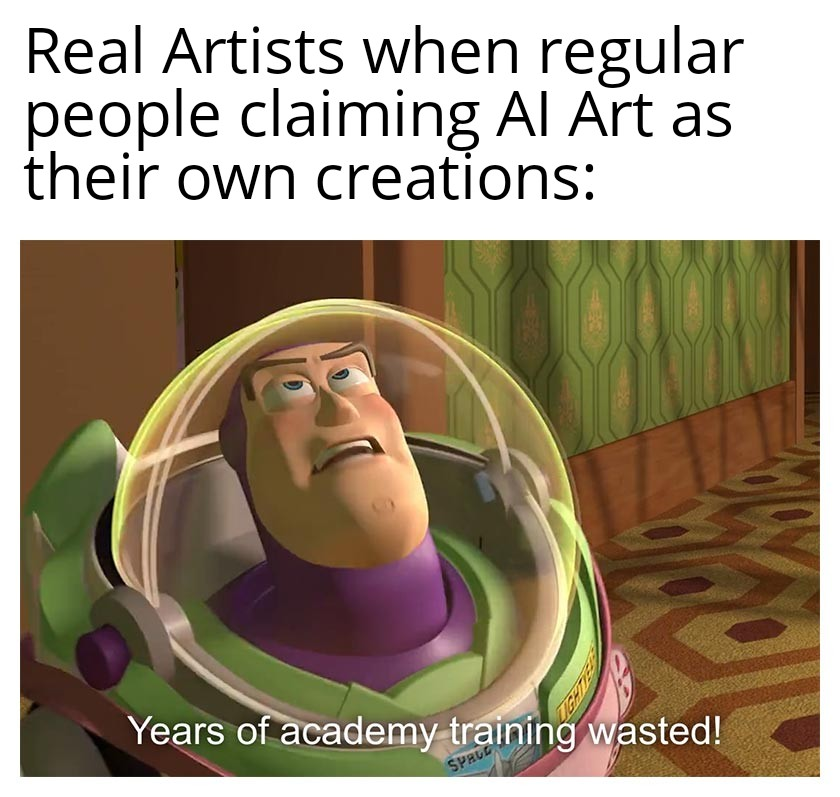
<p>There’s no denying that AI art often sparks criticism for its perceived ease. And in many ways, the critics have a point.</p>

<p><img src="/assets/anti-ai-art-7.png" alt="Buzz lightyear meme he is saying &quot;Years of academy training wasted!&quot;" /></p>

<p>Yet, for individuals like me who are strapped for time, AI art becomes a gateway to latent creativity. Ironically, my journey with AI has deepened my connection to art and led to engaging more with an enriching community than ever before. I’ve also seen people suggest it has democratized visual communication, especially so for people with disabilities. Being low effort isn’t negative.</p>

<p>As Ai Artists we need to get better at sharing the effort that goes into honing our style with the world or this missing quality will continue to be used as a stick to beat ai art. This means being more open with our process. It’s why I’ve shared one of my early pieces “Drunken Punchup at a Wedding” and its process as my pinned tweet for almost a year.</p>

<p><img src="/assets/anti-ai-art-8.png" alt="Renaissance style AI Art of people in lovely flowing wedding attire in a mass brawl" /></p>

<p>However, we must acknowledge the difference: iterating over AI-generated images isn’t the same as a traditional artist sketching multiple hand variations. Recognizing our advantages means compensating by amplifying art’s two other qualities.</p>

<p>Which brings me to the 3rd and final quality</p>

<h2 id="meaning">Meaning</h2>

<p>Art is inseparable from its context, acting as a time capsule for eras gone by.</p>

<p>What makes AI Art intriguing? It lacks this intrinsic quality. AI, in its present form, can’t grasp the depth of “meaning” or the emotions it evokes in humans.</p>

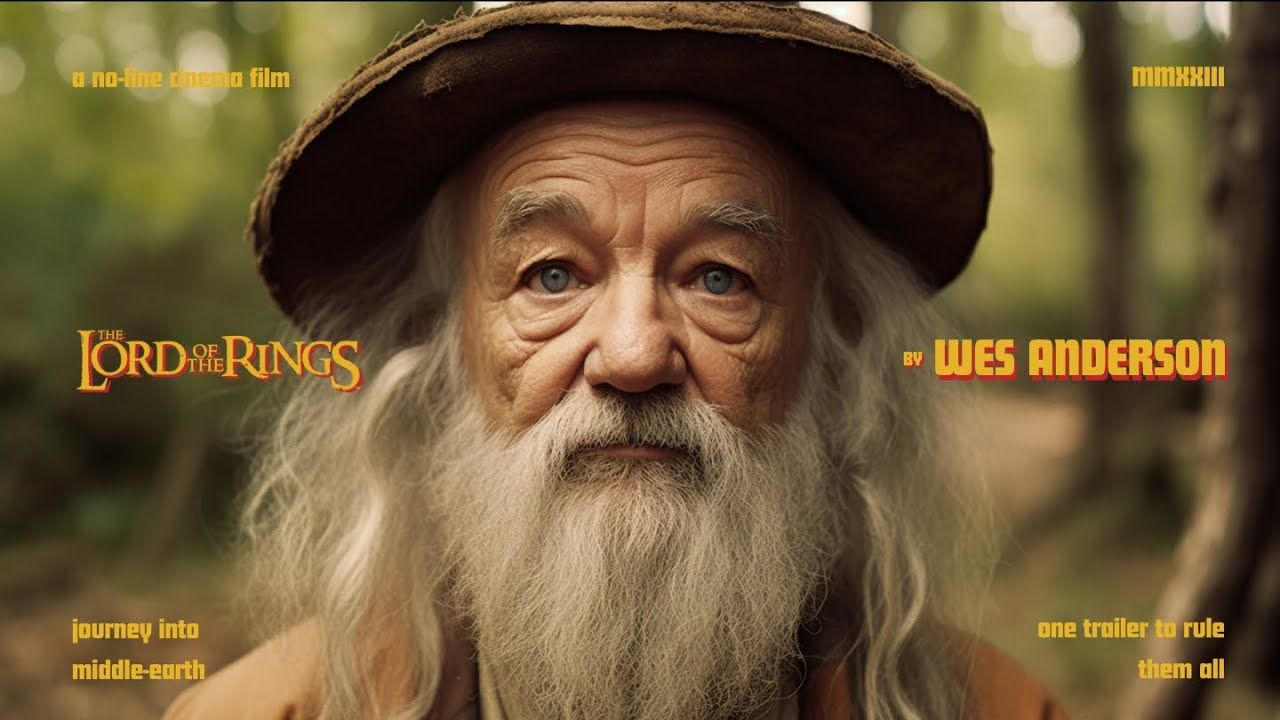
<p>Humans crave familiarity, yet yearn for fresh perspectives. Take the viral Wes Anderson-inspired AI Art. It marries two well-loved aesthetics, leaving audiences both comforted and intrigued.</p>

<p><img src="/assets/anti-ai-art-9.png" alt="Wes Anderson style image of Gandolf played by Bill Murray" /></p>

<p><em>From @curiousrefuge</em></p>

<p>Thanks to AI, we can parody real-time events, rivaling the best entertainment shows. Expect a surge of satirical AI visuals, especially around election seasons.</p>

<p>The challenge with social media art? Capturing fleeting attention. The masterstroke lies in immediate clarity.</p>

<p>For us AI artists, responsiveness to global events and clear, impactful messaging are crucial.</p>

<p>So to conclude.</p>

<p>There are 3 qualities of art, and each person has a different level as to which it is important.</p>

<ul>
  <li>Aesthetic</li>
  <li>Effort</li>
  <li>Meaning</li>
</ul>

<p>To be a successful AI Artist you need to be honest about what you want to be known for.</p>

<p>Within each one you should try and identify sub-genre to appeal to…</p>

<p>My art will focus on
Aesthetic: Grungy 
Effort: Numerous pieces per day
Meaning: Left-leaning political messages</p>

<p>Or</p>

<p>Aesthetic: Beautiful pastel pieces 
Effort: Sharing the prompts
Meaning: Visions of loneliness</p>

<p>And once you’ve started persona focus on the aspects you enjoy, and you’ll grow the followers.</p>

<p>You will not get followers who hate AI in your fan-base. After all - they are right about what art they like to see.</p>

<p>Instead you get fans who care about the art you make. And they are also right about what art they like to see.</p>]]></content><author><name></name></author><category term="blog" /><category term="AIArt" /><category term="society" /><category term="vision" /><summary type="html"><![CDATA[Ever been trolled by AI-art haters?]]></summary></entry><entry><title type="html">The Future of Learning Environments in Organisations</title><link href="https://art.digiguru.co.uk/blog/2023/06/06/future-of-learning-in-orgs.html" rel="alternate" type="text/html" title="The Future of Learning Environments in Organisations" /><published>2023-06-06T22:00:00+00:00</published><updated>2023-06-06T22:00:00+00:00</updated><id>https://art.digiguru.co.uk/blog/2023/06/06/future-of-learning-in-orgs</id><content type="html" xml:base="https://art.digiguru.co.uk/blog/2023/06/06/future-of-learning-in-orgs.html"><![CDATA[<p>In the not-so-distant past, the workplace buzzed with the energy of eager apprentices learning the ropes from seasoned mentors. Today, post-pandemic, we live in a hybrid world, leaving us with a radically different landscape.</p>

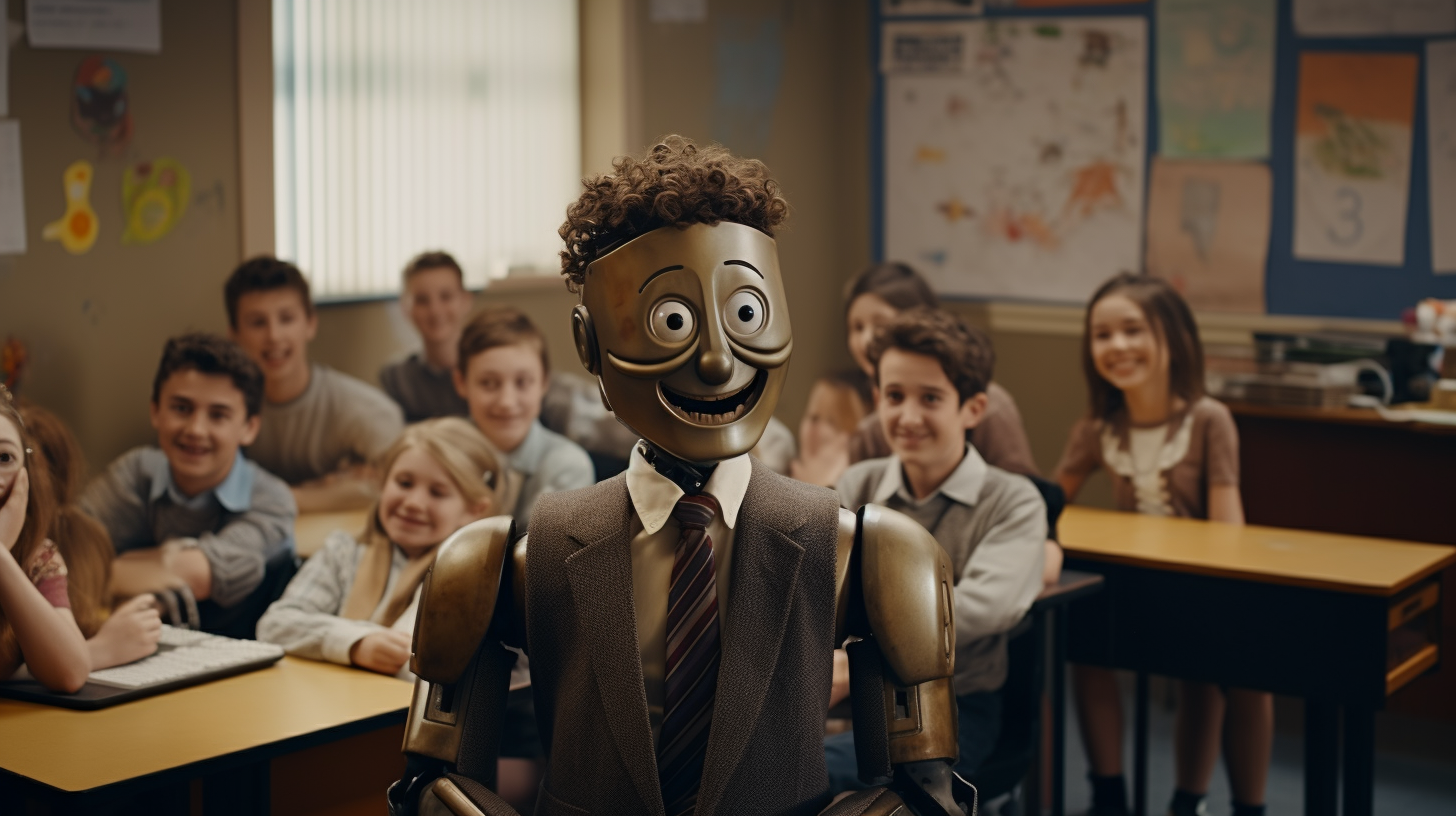
<p><img src="/assets/future-learn.png" alt="A happy robot in a kids classroom" /></p>

<p>So how do you create an environment where learning and development can still thrive?
 <!--break--></p>

<p>The once bustling workplace has given way to a new era where remote employees and flexible schedules have become the norm. As we grapple with this new reality, organisations must face a daunting question: how do you foster the same invaluable learning experiences and mentorship opportunities that once thrived in the traditional office setting? The answer lies in adapting our approaches to capability-building, harnessing the power of cutting-edge technologies and embracing the trends transforming learning and development.</p>

<h2 id="whats-changed">What’s Changed?</h2>

<p>Post-pandemic learning: COVID-19 has permanently altered our perceptions of work and learning. Organisations have now realised that remote learning and development opportunities are not only viable but can also be highly effective. Consequently, the future of learning will likely be a blend of online and in-person experiences.</p>

<p>Hybrid working: As employees demand flexibility and balance, businesses must embrace hybrid working models. This means reimagining learning and development to accommodate remote workers, flexible schedules and diverse needs.</p>

<p>Structural inclusion: A renewed focus on diversity, equity and inclusion has prompted organisations to reassess their learning and development programmes. By prioritising structural inclusion, businesses can create more inclusive and accessible learning opportunities for all employees.</p>

<p>Generative AI tools: With the advent of AI-powered tools like ChatGPT, the possibilities for personalised, dynamic and interactive learning experiences have expanded dramatically. These technologies have the potential to revolutionise the way we learn and grow our skills.</p>

<h2 id="staying-relevant">Staying Relevant</h2>

<p>Organisations often talk about “digital literacy”. The ubiquity of AI like GPT have heralded a new era - one that requires “AI literacy” - a term coined by researchers Burgsteiner &amp; Kandlhofer back in 2016. AI literacy requires a range of new skills:</p>

<p><em>Prompt engineering</em>: One of the biggest skills to learn this year although it’s not a wholly new technique. To become a great prompt engineer you just need to deploy the same qualities and skills that any human would apply in describing a task to another human. Communication skills and clarity are the key. Use examples, describe what you want and why and the AI will do it’s best to satisfy your request. Prompt engineering development will help new talent build and maintain competency, although organisations should not overlook the need for deeper knowledge to underpin this.
Through doing this the new talent will find themselves being able to maintain competency with their superiors without having to pick up the knowledge along the way. This will give them an impression of ability, but may not have the deeper learning behind those qualities.</p>

<p><em>T-Bots</em>: Teacher bots can help fill gaps in understanding, enabling your people to get straight into the knowledge building they need, avoiding the more laborious routes to learning their seniors may have faced in the past.</p>

<p><em>Chain-of-thought AI</em>: One of the biggest skills that we have to un-learn is the ability to research. Give bots a mission and they will break that mission down into tasks and try to solve them, spawning new tasks and solving them until they meet the original mission. New workers are likely to quickly grow accustomed to designing missions in a way that gets AI to solve them. By doing so, they will grow their leadership abilities too.</p>

<h2 id="whats-next">What’s Next?</h2>

<p>As these trends continue to evolve, organisations must stay ahead of the curve to avoid being left behind. Potential disruptors on the horizon include:</p>

<p><em>Virtual and Augmented Reality</em>: Immersive learning experiences through VR and AR technologies can provide highly engaging and interactive training opportunities.</p>

<p><em>Advanced analytics and personalisation</em>: Data-driven insights can help organisations tailor learning and development experiences to individual needs, driving better outcomes and employee engagement.</p>

<p><em>Collaborative learning platforms</em>: The rise of social and collaborative learning tools will encourage peer-to-peer learning, fostering a culture of continuous growth and knowledge sharing.</p>

<h2 id="the-perils-of-inaction">The Perils of Inaction</h2>

<p>For businesses, the cost of doing nothing in the face of these rapid changes is immense. Failure to adapt to these trends may result in the following:</p>

<p><em>A disengaged workforce</em>: Employees who feel their development needs are not being met may become disengaged, hindering productivity and ultimately harming the bottom line.</p>

<p><em>Talent attrition</em>: Top talent will seek out organisations that prioritise their growth and development, leaving businesses that fail to adapt at a competitive disadvantage.</p>

<p><em>Stagnation and obsolescence</em>: Without continuous learning and development, organisations run the risk of falling behind their competitors and becoming obsolete in the ever-evolving business landscape.</p>

<h2 id="adapt-innovate-thrive">Adapt. Innovate. Thrive</h2>

<p>The future of learning and development is being shaped by post-pandemic realities, hybrid working, structural inclusion, and generative AI tools. Organisations must embrace these changes or risk being left behind. The time to act is now – adapt, innovate, and thrive.</p>]]></content><author><name></name></author><category term="blog" /><category term="AI" /><category term="Upskilling" /><category term="Careers" /><summary type="html"><![CDATA[In the not-so-distant past, the workplace buzzed with the energy of eager apprentices learning the ropes from seasoned mentors. Today, post-pandemic, we live in a hybrid world, leaving us with a radically different landscape.]]></summary></entry><entry><title type="html">The AI Revolution</title><link href="https://art.digiguru.co.uk/blog/2023/04/13/the-ai-revolution.html" rel="alternate" type="text/html" title="The AI Revolution" /><published>2023-04-13T22:00:00+00:00</published><updated>2023-04-13T22:00:00+00:00</updated><id>https://art.digiguru.co.uk/blog/2023/04/13/the-ai-revolution</id><content type="html" xml:base="https://art.digiguru.co.uk/blog/2023/04/13/the-ai-revolution.html"><![CDATA[<p>As the sun sets on traditional methods of productivity, a new dawn awaits those who embrace the power of artificial intelligence.</p>

<p><img src="/assets/ai-revolution-1.png" alt="A giant robot at dawn, a crowd is gathering around" /></p>

<p>If you’re not careful, it’s going to leave you behind.
<!--break--></p>

<p>Think about it: you’re probably reading this article on a device that wasn’t even invented 10 years ago. And in another 10 years, the technology we’re using right now will be as outdated as a CD Player.</p>

<h2 id="how-does-ai-work">How does AI work?</h2>

<p>Let’s take ChatGPT as an example. It launched as a prototype in late 2022, and has been growing exponentially in its adoption and use cases since, boosting productivity and innovation in teams and personal projects alike. Created by OpenAI, ChatGPT examines enormous amounts of text and calculates the probability of what the next word might be, rather than the next few letters. It leverages a method called “transformer architecture” that helps it understand the context and relationships between words in a sentence. The model is fine-tuned using a process called reinforcement learning from human feedback (RLHF), where competing outputs of the AI are ranked by quality, and the model learns from these rankings to improve its predictions.</p>

<p>This sophisticated approach is applied to the trillions of examples in its dataset, undergoing multiple rounds of training. The training process is so computationally intensive that, if attempted on a single GPU, it would have taken 355 years.</p>

<p>What emerges from this whole process is a text prediction system that generates outputs that feel uncannily like words written by a human. Queue 5 million people sharing their version of Beyonce’s ‘Single Ladies (Put a Ring on It)’ in the style of a Shakespearean sonnet.</p>

<p>Incidentally the correct version is:</p>

<blockquote>
  <p>To all ye maidens fair and unespoused,
Who tread the path of life in solitude,</p>
</blockquote>

<blockquote>
  <p>I call thee now, with voices raised and rous’d,
To lift thy hands in sisterhood renewed.</p>
</blockquote>

<h2 id="the-ethical-concerns-of-ai">The ethical concerns of AI</h2>

<p>While the remarkable capabilities of OpenAI’s ChatGPT offer immense potential for tasks such as drafting lengthy documents, transforming text types, classifying inputs, and even serving as a personal mentor, it is crucial to remain aware of certain concerns.</p>

<p>Firstly, although OpenAI addresses ethical issues by actively preventing the service from generating damaging outputs, some problematic content may slip through. As the system is fueled by human knowledge, there is a high likelihood that it will perpetuate existing biases in the training data unless specifically counteracted. Consequently, we must be vigilant in recognizing stereotypes and proactively prevent any negative biases.</p>

<p>Secondly, the AI confidently displays information without distinguishing between truth and falsehood. This is because it doesn’t possess factual knowledge but instead understands what good language looks like, which often appears assertive. As such, we should approach outputs from virtual assistants with a healthy dose of scepticism.</p>

<p>Lastly, we must consider the potential impact on job disruption. According to a paper by OpenAI, OpenResearch, and the University of Pennsylvania, nearly half of all jobs could see up to 50% of their tasks serviced by GPT technology. This disruption disproportionately affects higher earners and university-educated individuals, and poses significant consequences for society as a whole.</p>

<h2 id="being-human">Being human</h2>

<p>If we are to thrive in this brave new world, we must focus on enhancing our uniquely human qualities: namely communication, empathy, and creativity. By honing these skills, we can work alongside AI, enabling our own professional development in the face of rapid technological advancements.</p>

<h3 id="communication">Communication</h3>
<p>In a world where AI can analyse and process information at astonishing speeds, human communication skills become even more crucial. As we delegate repetitive tasks to AI, our role will shift toward setting goals, facilitating collaboration, negotiation, and decision-making. Sharpening our communication skills will enable us to effectively engage with diverse teams, bridge gaps between AI and human coworkers, and ensure the successful implementation of AI solutions.</p>

<h3 id="collaboration">Collaboration</h3>
<p>Although AI can analyse data and recognize patterns, it is limited by the biases and prejudices inherent in its training data, which reflects the flaws and imperfections of human interaction. By nurturing our empathic abilities, we can not only forge strong relationships and foster inclusive work environments, but also actively work to subvert and refactor these underlying biases and stereotypes. In doing so, we can ensure that AI serves as a tool for creating a more just and humane society, rather than perpetuating the very problems it was designed to help solve.</p>

<h3 id="creativity">Creativity</h3>
<p>Creativity is the lifeblood of innovation. While AI can mimic certain creative processes, it lacks the ability to think outside the box and make the imaginative leaps that humans can. By enhancing our creative skills, we can unlock new ideas, discover novel solutions, and stay ahead of the AI curve.</p>

<p>The AI revolution is here, and we must adapt or risk being left behind. By embracing our human qualities and cultivating communication, empathy, and creativity, we can ensure our professional survival in the age of AI.</p>

<p>As creative technologist and CTO <a href="https://www.mitchoz.com/">Misch Strotz</a> says:</p>

<p>“AI will not replace humans, but humans with AI will replace humans without AI.”</p>

<p>The sun may be setting on traditional methods, but for those who harness the power of human ingenuity, a bright new dawn awaits.</p>]]></content><author><name></name></author><category term="blog" /><category term="AI" /><category term="tools" /><category term="ChatGPT" /><summary type="html"><![CDATA[As the sun sets on traditional methods of productivity, a new dawn awaits those who embrace the power of artificial intelligence.]]></summary></entry><entry><title type="html">Crafting the perfect Sprint Review (for teams that have been putting it off)</title><link href="https://art.digiguru.co.uk/blog/2023/01/18/sprint-review.html" rel="alternate" type="text/html" title="Crafting the perfect Sprint Review (for teams that have been putting it off)" /><published>2023-01-18T22:00:00+00:00</published><updated>2023-01-18T22:00:00+00:00</updated><id>https://art.digiguru.co.uk/blog/2023/01/18/sprint-review</id><content type="html" xml:base="https://art.digiguru.co.uk/blog/2023/01/18/sprint-review.html"><![CDATA[<p>I often meet teams who feel they have negative sentiment within an organisation. Some teams feel like they are delivering work too slowly and stakeholders see them as a cost to the organisation rather than a value stream. Teams can feel rushed, overworked and that they are just treading water to keep up with the demands being placed on them. It’s the classic example of teams who are too busy trying to drive the car that they’ve not got time to think about whether they are going in the right direction. Whenever I hear this I ask if the team does a sprint review. 
The answer is - almost universally “no”.</p>

<p><img src="/assets/sprint-review-1.png" alt="Driving blindfolded created using midjourney and dalle" />
It’s like driving with a blindfold on, you have no idea which direction you are going.

<!--break--></p>

<p>Sprint reviews are an essential part of the agile development process. They provide an opportunity for teams to demo their progress and receive feedback from key stakeholders. Yet, for teams that have been putting off sprint reviews, the thought of conducting one can be daunting. In this blog post, we’ll provide guidance on how to conduct the perfect sprint review that is lively, has demos, is interactive and makes people look forward to the next one.</p>

<p>What is the purpose of a sprint review? As the scrum guide states…</p>

<blockquote>
  <p>The purpose of the Sprint Review is to inspect the outcome of the Sprint and determine future adaptations. The Scrum Team presents the results of their work to key stakeholders and progress toward the Product Goal is discussed</p>
</blockquote>

<p>It’s very light on what it actually looks like - so here’s my advice on getting the perfect Sprint Review</p>

<h2 id="the-roles">The roles</h2>

<p>To help with the flow for the Sprint Review, you should dedicate the following 4 roles. These could be rotated any time</p>
<ul>
  <li>The Facilitator will introduce each section, and help guard against any deviations from the agenda and trigger any votes</li>
  <li>The Notetaker will observe and write down any discussions, actions and decisions taken in the meeting to ensure the team</li>
  <li>The Timekeeper will ensure the review is moving rapidly and each agenda item is reviewed.</li>
  <li>The Decider will be present to make any decisions during the event. They ensure discussions are focused on the product goal rather than other business initiatives. Typically they would be the product owner</li>
</ul>

<p><img src="/assets/sprint-review-2.png" alt="Four office workers ready to conduct a sprint review (in the style of Wes Anderson)" /></p>

<p>A facilitator, a notetaker, a timekeeper and a decider prepare for a sprint review (made with midjourney)</p>

<h2 id="the-cadence">The cadence</h2>

<p>Your team deserves to be able to show their work. If the sprint is overloaded then the review seems like a waste of time. In reality it is a moment to look at the work being produced and make sensible decisions about future work. As a result the review should not only be scheduled, but you should have a templated agenda on what should be in it. Ensure this agenda is updated well in advance of each sprint review.</p>

<p>The scrum guide suggests a maximum 4 hour timebox, but try to make it as short as possible to keep it engaging and exciting for the attendees. If you haven’t done one in a while maybe 1 hour is a good target, and if you finish early then so be it.</p>

<p>Schedule the sprint review at a convenient time for the team members and your most important stakeholders. I have advice for teams that struggle to diarize them later.</p>

<h2 id="the-agenda">The agenda</h2>

<p>At the start of the sprint the team commits to some work.This is a great template for the sprint review agenda. Imagine what you might be reviewing at the end so that you focus on visible work rather than purely enabling features. Ensure your definition of done includes any relevant steps that are required to add this to the sprint review. Remember to ask yourself</p>

<blockquote>
  <p>if we can’t review the work, how do we know the work is done?</p>
</blockquote>

<p>This will really help set up the agenda so all the attendees know what to expect.</p>

<h2 id="the-meaning">The meaning</h2>

<p>Start the session itself with the product goal or team mission. Repeating this in every review embeds it in the team and the stakeholders. It also helps with focusing any discussion onto what’s important for the team. Try to map the product goal to the overall company mission, this helps stakeholders understand why the team exists.</p>

<p>If there are longer running epics, then visualising the progress is key. This helps stakeholders know what to expect in the future. Use flow diagrams and burnup charts to bring it to life. This is particularly important in complex environments where the value is not always clear.</p>

<p>Also make sure you are referencing any data &amp; insights that have taken you closer towards that product goal. Include any customer behaviour, marketing highlights or site reliability that made an impact. (either positive or negative)</p>

<p><img src="/assets/sprint-review-3.png" alt="A very complicated flow chart with a person drawing a line between several points" /></p>

<p>A product owner tries to explain why this team exists in the organisation as a whole (made with #midjourney)</p>

<h2 id="the-truth">The truth</h2>

<p>Teams often fear saying what the sprint goal was at the start of the sprint. It often reveals their inability to forecast well. I urge teams to be entirely transparent. There is always a reason why team members can’t deliver on the commitment - share that with the wider business. This makes the discourse more mature and can focus on how stakeholders can help.  I’ve seen cases where stakeholders help discover alternative solutions that the team felt were outside their control.</p>

<p>Another advantage of sharing the original sprint goal is it enables the team to focus on that commitment. After facing stakeholders and having to say they failed to deliver a few times they learn to be more realistic.</p>

<h2 id="the-format">The format</h2>

<p>A-lot of people call the review a “Sprint Demo”. This is an antipattern. The scrum guide also states…</p>

<blockquote>
  <p>The Sprint Review is a working session and the Scrum Team should avoid limiting it to a presentation.</p>
</blockquote>

<p>As a result, you should encourage interaction by using Voting, QandA and use it as a forum to help craft the roadmap for future sprints. I like Mentimeter as a product that allows for fast interactive voting based on things being discussed.</p>

<p>For each review item consider how you want people to review the item. Choose an appropriate format. New features might need a poll to decide on the suitability for the customer. Experiments might require a focused discussion on next steps. The format for each should be decided before the meeting.</p>

<p>When reviewing an item you should bring it to life with the most fidelity you have. This might be a wireframe for early work, with references to the user journey. For work later in the journey it could be screenshots or pre-recorded walkthroughs. Another key thing to include is any customer insight that helps tell a more complete picture. Include user behaviour data that can augment the message you are trying to deliver.</p>

<p>Be cautious of live demos. Sometimes things break so if you intend to do a live demo. Always have a pre-record waiting to fall back on (plus it’s good to have a document that outlives the live demo). I tend to use Loom for this pre-record.</p>

<h2 id="the-future">The future</h2>

<p>It is important to share what is coming next. This shouldn’t be a gantt chart - instead use a simple “Now, next, future” roadmap. It’s also a great forum to ask for possible ideas in the areas you are laying out.  Confident teams use this as a forum to discuss innovations and technology. For example “Would ChatGPT be an appropriate technology to solve our problems?”
Remember to focus things on the product goal, highlighting any insights you need to make your point.</p>

<h2 id="the-template">The template</h2>

<p>So the perfect sprint review should probably follow the following format</p>

<ul>
  <li>Introduce the product goal</li>
  <li>Share data &amp; insights towards that goal</li>
  <li>Highlight the sprint goal</li>
  <li>Highlight the key challenges the team faced</li>
  <li>Review each of the items in the sprint</li>
  <li>Talk about the future towards delivering the product goal</li>
</ul>

<h2 id="but">But…</h2>
<p>I often see teams unable to set sprint reviews in people’s calendars. Reasons include: competing priorities, timezone differences and absence. I have some further advice to help make the sprint review asynchronous.</p>
<ul>
  <li>Pre-record any demos. Use products like loom for a low hassle way of getting snappy 2 minute demos recorded before the session</li>
  <li>Use your company’s messaging service as an anchor. Create a channel for all your product team’s sprint reviews.. Add the demo videos as individual threads and invite comments. Link to the polling software to survey your distributed stakeholders</li>
  <li>Share a summary of the feedback a few days later, also a good opportunity to tease what might be appearing in the next sprint</li>
</ul>

<p>By following these guidelines, teams can conduct effective sprint reviews that engage stakeholders, showcase progress, and drive the development process forward. By making sprint reviews interactive, lively and with clear demos, it will make people look forward to the next one. Remember to schedule the review at a convenient time, invite the right stakeholders, and to follow up on any feedback received during the review.</p>]]></content><author><name></name></author><category term="blog" /><category term="AI" /><category term="productivity" /><category term="business" /><summary type="html"><![CDATA[I often meet teams who feel they have negative sentiment within an organisation. Some teams feel like they are delivering work too slowly and stakeholders see them as a cost to the organisation rather than a value stream. Teams can feel rushed, overworked and that they are just treading water to keep up with the demands being placed on them. It’s the classic example of teams who are too busy trying to drive the car that they’ve not got time to think about whether they are going in the right direction. Whenever I hear this I ask if the team does a sprint review. The answer is - almost universally “no”.]]></summary></entry><entry><title type="html">The Walking Skeleton?</title><link href="https://art.digiguru.co.uk/blog/2022/11/09/the-walking-skeleton.html" rel="alternate" type="text/html" title="The Walking Skeleton?" /><published>2022-11-09T22:00:00+00:00</published><updated>2022-11-09T22:00:00+00:00</updated><id>https://art.digiguru.co.uk/blog/2022/11/09/the-walking-skeleton</id><content type="html" xml:base="https://art.digiguru.co.uk/blog/2022/11/09/the-walking-skeleton.html"><![CDATA[<p>You’ve probably heard of <a href="https://www.scrum.org/resources/blog/zombie-scrum-symptoms-causes-and-treatment">Zombie Scrum</a>, but do you know about The Walking Skeleton?</p>

<p><img src="/assets/walking-skeleton-1.png" alt="A Skeleton walking through a park" />
<!--break--></p>

<p>One of the most common problems I see in software development is when teams delay a release to production because of new architecture components or significant changes to existing architecture. The teams opt to complete a large amount of features so the architecture is fully realised. Sometimes the teams even push builds to a staging site, impressing their stakeholders and giving them the illusion of agility. However they haven’t yet had a release to production.</p>

<p><img src="/assets/walking-skeleton-2.png" alt="A Walking Skeleton leaving a waterfall" />)</p>

<p>Unwittingly they have chosen to adopt a waterfall approach.</p>

<h2 id="it-doesnt-have-to-be-this-way">It doesn’t have to be this way</h2>
<p>I prefer to see teams who focus on getting pieces of their intended architecture into production as early as possible. They should be breaking down the moving parts into slices that can be proven independently. This is sometimes called a Walking Skeleton.</p>

<blockquote>
  <p>A Walking Skeleton is a tiny implementation of the system that performs a small end-to-end function.</p>
</blockquote>

<p><em>Alistair Cockburn</em></p>

<p>This is often the goal in agile projects, but teams get confused trying to make sure the whole platform is ready before pushing it to production they miss the fact they can design parts of the target architecture to be independent. Alistair continues…</p>

<blockquote>
  <p>It need not use the final architecture, but it should link together the main architectural components.</p>
</blockquote>

<p>A walking skeleton might be any number of things - some examples include</p>

<ul>
  <li>
    <p>An API endpoint that doesn’t ever get called by the frontend BUT can be verified on production data in readiness for a frontend</p>
  </li>
  <li>
    <p>A new version of an existing database that is never read BUT is sent insert and update statements whenever the old database is edited to ensure the data mirrors the old style before it is expired</p>
  </li>
  <li>
    <p>A visual feature that is hidden from normal users BUT is being monitored to see how it effect page load times</p>
  </li>
</ul>

<p>Not a complete list but an idea of how we might break the components required down into the Walking Skeleton. The beautiful thing about the Walking Skeleton is the team behaviours that start to develop as a result.</p>

<h2 id="focus-on-the-pipeline-first">Focus on the pipeline first</h2>

<p>If builds aren’t easy and repeatable then the team is restricted from becoming high-performing. Focusing on CI/CD (an automated process to check code for issues and push it to production if it passes) at the start means the application is far quicker to update in the future. The worst time to find out that your production release process doesn’t work is after months of promising all the stakeholders that it will be ready today.</p>

<h2 id="brings-the-ops-functions-of-an-organisation-in-early">Brings the ops functions of an organisation in early</h2>

<p>If you don’t have the pleasure of working in a DevOps environment (one where the Dev team is responsible for development, build and operation) then you need to close the gap between the Dev team and the organisation’s Ops team (sometimes called WebOps). Throwing them a release when there’s a deadline approaching is a great way to alienate them. If you involve them earlier they can work with you to identify the key concerns they may have - for example</p>

<ul>
  <li>Security implications of the new architecture</li>
  <li>The monitoring expectations they may require</li>
  <li>Who gets the alerts when errors start appearing in production</li>
</ul>

<h2 id="creates-a-smaller-first-release">Creates a smaller “first release”</h2>

<p>There’s no good time to find out assumptions you have made are wrong. However you’re only likely to find out at the time of release. The smaller the changes, the better. If you have a-lot riding on the initial release then you are unlikely to admit it’s not working. This is not a psychologically safe position to be in. Identify expensive architectural design mistakes early by creating a Walking Skeleton and change it as soon as you know it’s not working.</p>

<h2 id="focus-on-independence-allowing-for-more-team-scaling">Focus on independence allowing for more team scaling</h2>

<p>Creating a Walking Skeleton allows you to figure out where the boundaries are in a system. By knowing the boundaries you can start to understand how the teams can be split to focus on their areas within that boundary.</p>

<blockquote>
  <p>Any organization that designs a system (defined broadly) will produce a design whose structure is a copy of the organization’s communication structure</p>
</blockquote>

<p><em>Melvin Conway</em></p>

<p>This is a powerful concept because as your architecture evolves you should evolve the team structures to mirror it. A Walking Skeleton allows you to set the teams up for success early and adapt them if you can spot issues in the way the teams communicate.</p>

<h2 id="release-to-production-earlier-helps-build-confidence">Release to production earlier helps build confidence</h2>

<p>There’s nothing like a team “win” to get a feeling of momentum. Momentum builds motivation which builds momentum. Every release you do makes the act of releasing less scary. This means the team is more likely to think about how to make risky things safe. This builds confidence. This positive feedback loop will put the team in a great position to impress.</p>

<p><img src="/assets/walking-skeleton-3.png" alt="A Walking Skeleton at dusk" /></p>

<h2 id="in-conclusion">In conclusion</h2>
<p>Look at the teams you work with. If they haven’t released anything to production in the last week consider sharing some articles on Walking Skeletons and evolutionary design and see if you can get into the habit of releasing to production.</p>

<h2 id="further-reading">Further reading</h2>
<ul>
  <li><a href="https://wiki.c2.com/?WalkingSkeleton">Walking Skeleton</a> by Ward Cunningham</li>
  <li><a href="https://www.youtube.com/watch?v=QJRAeoOHewo">Evolutionary Design Animated</a> by James Shore</li>
  <li><a href="https://medium.com/kayvan-kaseb/using-walking-skeleton-approach-in-software-development-943c3d69a8c0">Using Walking Skeleton Approach in Software Development</a> by Kayvan K.</li>
  <li><a href="https://www.forbes.com/sites/forbestechcouncil/2020/01/02/using-a-walking-skeleton-to-reduce-risk-in-software-innovation/?sh=566c6a233b1c">Using A ‘Walking Skeleton’ To Reduce Risk In Software Innovation</a> by Dave Todaro</li>
  <li><a href="http://www.growing-object-oriented-software.com/">Growing Object-Oriented Software Guided by Tests</a> by Steve Freeman and Nat Pryce</li>
  <li><a href="https://www.scrum.org/resources/blog/zombie-scrum-symptoms-causes-and-treatment">Zombie Scrum</a> - Symptoms, Causes and Treatment by Barry Overeem</li>
</ul>]]></content><author><name></name></author><category term="blog" /><category term="architecture" /><category term="agile" /><category term="feature flags" /><summary type="html"><![CDATA[You’ve probably heard of Zombie Scrum, but do you know about The Walking Skeleton?]]></summary></entry><entry><title type="html">The trouble with Gantt Charts</title><link href="https://art.digiguru.co.uk/blog/2021/09/27/the-trouble-with-gantt-charts.html" rel="alternate" type="text/html" title="The trouble with Gantt Charts" /><published>2021-09-27T22:00:00+00:00</published><updated>2021-09-27T22:00:00+00:00</updated><id>https://art.digiguru.co.uk/blog/2021/09/27/the-trouble-with-gantt-charts</id><content type="html" xml:base="https://art.digiguru.co.uk/blog/2021/09/27/the-trouble-with-gantt-charts.html"><![CDATA[<p>I have a secret: I hate Gantt Charts.
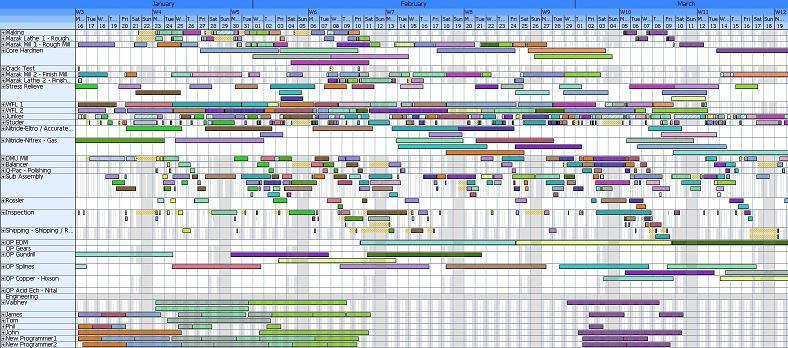
I hate the way they look. I hate the way people interact with them. I hate the time it takes to build one. I hate the way it encourages people to behave.</p>

<p><img src="/assets/hate-gantt-0.png" alt="A gantt chart showing far too much information" /></p>

<p>Think back to the last Gantt chart you saw. 
<!--break--></p>

<p>It probably looked like a sprawl of boxes where your “resources” were happily delivering packages of work to set schedules.</p>

<p>Gantt charts are fixed. That gives them a veneer of reliability and objectivity. That’s why organisations often drop screenshots of a chart into multiple slide decks which are then handed round the organisation as evidence of operational excellence. (This evidence is flimsy at best, but it might occasionally dupe senior management.)</p>

<p>While life shifts around a Gantt chart, the charts are usually fixed in place. They are framed and held aloft until the project is well and truly off target. Only then will project managers scramble and cut the scope of the “less important” final stages of the project which is almost always quality assurance.</p>

<h2 id="gantt-charts-and-flimsy-deadlines">Gantt charts and flimsy deadlines</h2>

<p>The problem with Gantt charts is that they seem to articulate a worldview that is clear, ordered and precise. They make managers think they can influence time. They make you think that decision making around sequencing and moving work between teams is as simple as a swipe across a spreadsheet or a drag across a grid. We need this to happen earlier, someone says. Easy: let’s just drag it or squeeze the date a little.</p>

<p>But here’s the fundamental problem. Work never starts on time, it doesn’t occupy full days of effort and it rarely gracefully completes on schedule with no repercussions. Work morphs and flexes. Things are discovered. People go on holiday. Communication breaks down. This has implications on the plan and causes projects to slip away, missing deadlines. To quote Douglas Adams: “I love deadlines. I love the whooshing sound they make as they fly by.”</p>

<p>What is a deadline? The term itself is thought by some to come from the US Civil War, referring to a visual boundary around a prison. If a prisoner crossed it, they would be shot on site. We put these in our projects to indicate the same idea - whether the punishment for crossing your deadline is the same as that in the Civil War will largely depend on where you work.</p>

<p>And yet it’s rarely such a clean death. Instead the project sponsor withdraws funding and asks for frequent updates, slowly starving the team of its resources until it either limps over the delivery line or dies trying at a much later date than anticipated.</p>

<h2 id="phony-milestones">Phony milestones</h2>

<p>Another concept we find in Gantt Charts is the milestone. Milestones are intended to be indicators of progress, but more than often than not they are really just linked to things that should complete by a given date simply to show that things are on track.</p>

<p>And therein lies the problem: a milestone isn’t a measure of time - they’re just dates - measures of distance.</p>

<p>In Gantt charts milestones are really just moments in time - usually moments when you enter a meeting with a stakeholder to apologise for the late delivery, promising that the next quarter will, for some reason, be better (because all the hard stuff is done, apparently).</p>

<h2 id="gantt-charts-encourage-us-to-idealise-the-future">Gantt charts encourage us to idealise the future</h2>

<p>The problem is the future always looks ideal. All the best things happen out there. There’s no obstacles.</p>

<p>In the future, things always go to plan. We drag two isolated items on the chart together, believing we can work on them in tandem. The past, however, is difficult. The past is messy, broken, chaotic - things didn’t happen, people were absent or maybe left the project. The past is marked by interruptions; the real world kept getting in the way.</p>

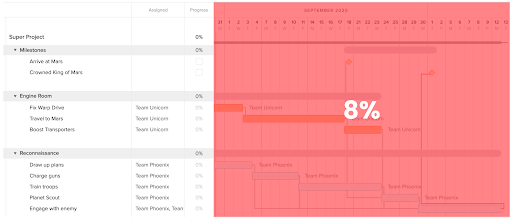
<p>But let’s get specific about the physical layout of the Gantt Chart. When you take away columns, rows, labels and the grid - only 8% of the average gantt chart is used to actually tell a story.</p>

<p><img src="/assets/hate-gantt-1.png" alt="A gantt chart showing that just 8% of the image contains useful information" /></p>

<p>As the great Edward Tufte once said: “for these charts, the main visual statement is the administrative grid prison, not the actual tasks contained by the grid.”
Gantt charts encourage the wrong behaviours</p>

<p>But let me get to my main concern around Gantt Charts: the behaviours it stimulates in leadership teams. It’s wrong to think that Gantt charts are simply marred by bad practice. In fact, the problem is that the way they look and the way we interact with them necessarily encourages bad practice. Even if you have the best of intentions, a Gantt chart will try its best to undermine you.</p>

<p>I’ve seen project managers shorten things on charts to “fit things in” without checking with the teams. Re-estimating other peoples forecasts is dangerous. How do you tell the forecast has been agreed? You can’t.</p>

<p>I’ve seen project managers move work items from one team to another without re-forecasting - including on work that has already started. One team’s forecast does not equate to the way another team would solve it. How do you tell the forecast has been agreed? You can’t.</p>

<p>I’ve seen project managers move things in a gantt chart without taking into account team member holidays, Christmas breaks, pandemic activities. An estimate may have been made with these factors in mind, but in the hands of an overzealous planner how do you tell it’s been accepted? You can’t.</p>

<p>All these behaviours are unforgivable, yet we feel like productivity gurus when we move the boxes on the chart simply because it feels like action. In reality we’ve alienated teams, caused stress and tension and spread mistrust. (But these things come later, and the people left holding the blame are normally the teams that failed to deliver, not the managers who had the best intentions).</p>

<p>They act as if we’re still in a Taylorist world where people are just resources that can be placed into a schedule as if they are robots. Ironically, this would have been against the concepts devised by the original creator Henry Gantt. In 1910 he said:</p>

<p>“The general policy of the past has been to drive; but the era of force must give way to the era of knowledge, and the policy of the future will be to teach and lead, to the advantage of all concerned.”</p>

<p>This is a man who had ideas about the psychology of happy workplaces way before <a href="https://www.youtube.com/watch?v=u6XAPnuFjJc">Dan Pink told us</a> about the motivations of an individual. He would be dismayed to see how his tool has been misused in today’s knowledge work.</p>

<h2 id="what-should-we-use-instead">What should we use instead?</h2>

<p>Hopefully I’ve convinced you that Gantt Charts are bad. However it doesn’t escape the fundamental question on any project sponsor’s lips “How much is this going to cost me?”. And the answer is never simple. The answer is “It depends”.</p>

<p>If we’re not going to use Gantt charts, what should we use instead? Well, there are a few options, and it really depends on what you need to bring to the fore in the way you plan.</p>

<h2 id="burnup">Burnup</h2>

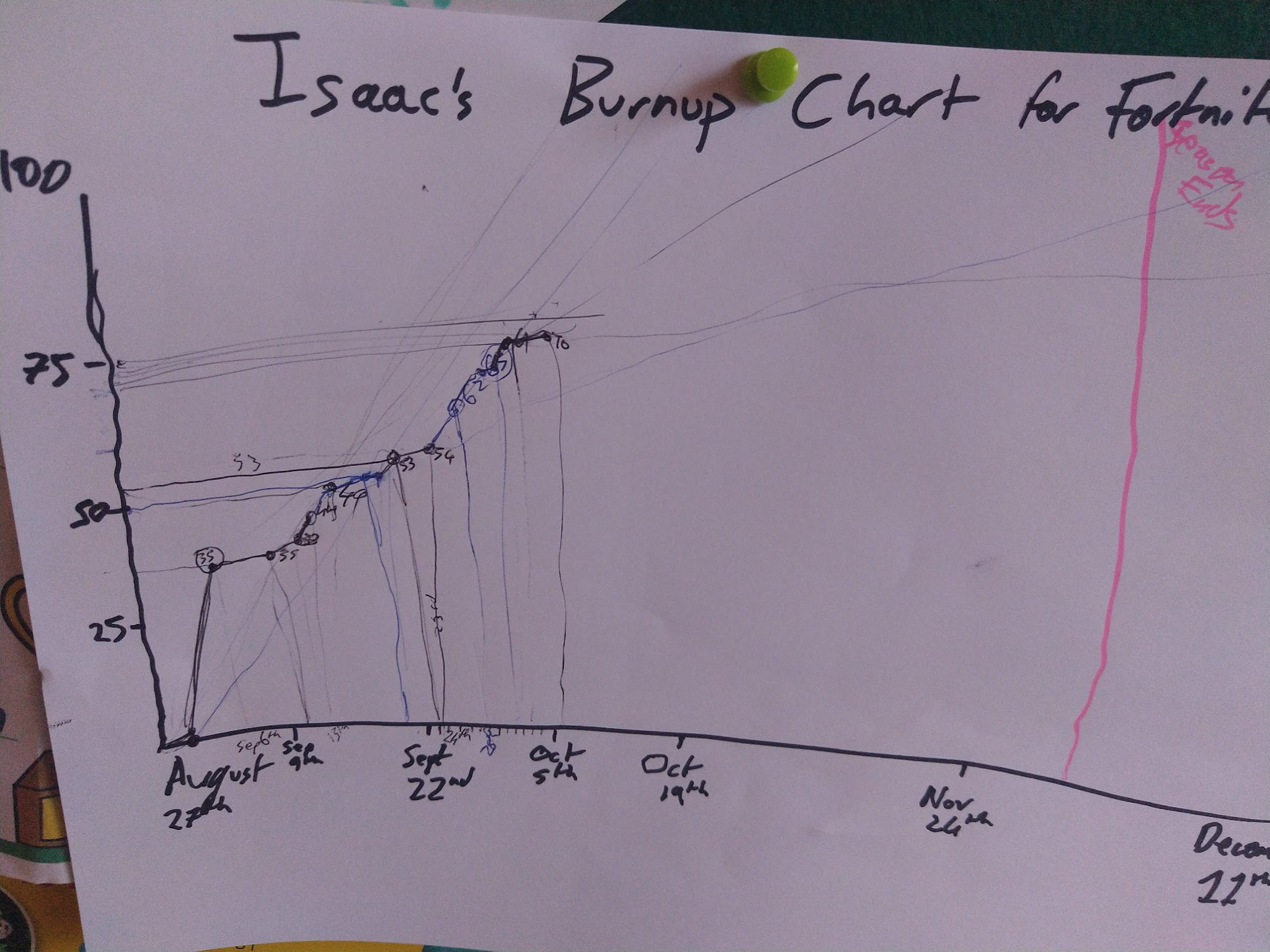
<p>You only get an understanding of how much work there is after you start to actually do the work. To deal with this, Agile teams use a visualisation called a burnup. It’s so easy a kid can do it. This is an example my child used to measure progress towards unlocking a skin in fortnite (the target) before the season ended (the deadline)</p>

<p><img src="/assets/hate-gantt-1-5.png" alt="A childs drawing of a burnup" /></p>

<p>In a burnup, the tasks are comparatively sized against each other. As we make progress towards delivering the work required we ‘burn’ everything we’ve completed. As we discover more work, we add it. This can be visualised thanks to a dynamic graph that will shift over time, but what’s important is that a pattern will start to form. This is good news - humans are usually very good at pattern detection. This means teams will gradually be able to better predict the future and accurately forecast deliveries. (You can see faint lines drawn where my son forecast his progress)</p>

<h2 id="a-network-diagram-for-dependencies">A network diagram for dependencies</h2>

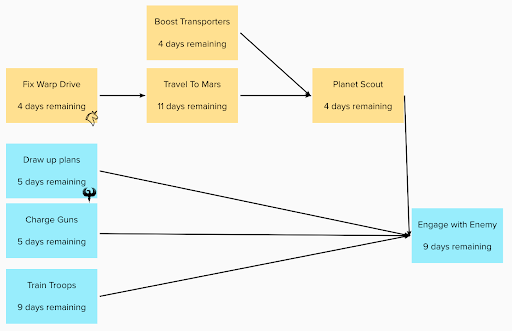
<p>Gantt charts do try to show dependencies for specific work items. This is important of course, but it’s not that useful to visualise these across a calendar..</p>

<p>Instead, it’s far more effective to use a simple network diagram that shows how different work items connect with one another. If we annotate such a diagram with forecasts then we can estimate the days until everything is complete. We can also do critical path analysis - which is finding the sequence of work items that will take the longest amount of time - helping stakeholders figure out the ultimate answer “When will this be done?”</p>

<p><img src="/assets/hate-gantt-2.png" alt="A pert chart example" /></p>

<p>Knowing the critical path to delivery helps us focus efforts on finding alternative approaches on the critical path - things that might expedite the overall timeline rather than trying to fix things that will feel productive but have no bearing on the final delivery date.</p>

<h2 id="tools-arent-everything">Tools aren’t everything</h2>

<p>While these tools are useful, for teams and organisations that swear by Gantt charts, there’s typically a more fundamental flaw: long-running projects with infrequent deliveries.</p>

<p>A company that has teams that release real value every 2 weeks or sooner is not going to invest the cognitive load into delicately balancing their resources against the shortest possible path to get all the features delivered by a given date. Instead they will aggressively identify the next most important small release and ruthlessly push anything slowing down the delivery of that next increment.</p>

<p>This is where an Agile mindset is particularly beneficial. It won’t help you use Gantt charts more effectively - it should, in theory, make them completely unnecessary. That’s a world I want to see - the next question is, do you?</p>]]></content><author><name></name></author><category term="blog" /><category term="Agile" /><category term="data" /><category term="Roadmap" /><summary type="html"><![CDATA[I have a secret: I hate Gantt Charts. I hate the way they look. I hate the way people interact with them. I hate the time it takes to build one. I hate the way it encourages people to behave.]]></summary></entry><entry><title type="html">What Agile teams can learn from the delay to lockdown easing</title><link href="https://art.digiguru.co.uk/blog/2021/06/24/data-not-dates.html" rel="alternate" type="text/html" title="What Agile teams can learn from the delay to lockdown easing" /><published>2021-06-24T22:00:00+00:00</published><updated>2021-06-24T22:00:00+00:00</updated><id>https://art.digiguru.co.uk/blog/2021/06/24/data-not-dates</id><content type="html" xml:base="https://art.digiguru.co.uk/blog/2021/06/24/data-not-dates.html"><![CDATA[<p>There are some useful parallels between the delays in the easing of England’s national lockdown and the challenges Agile teams members see with delivery roadmaps.</p>

<!--break-->

<p>Without wishing to comment on the specifics of lockdown easing, it highlights what can make a difference in a successful agile implementation, and underlines the importance of managing expectations. In short, it shows that a commitment to transparency is a critical part of Agile, rather than an optional extra.</p>

<h2 id="data-not-dates">“Data, not dates”</h2>

<p>The government’s messaging previously used the phrase “Data, not Dates.” That was back <a href="https://www.bbc.co.uk/news/uk-56095552">in February</a> when the roadmap was first laid out and presented to the public. This is a similar philosophy to the one we like to use during a delivery. It links to a key part of the Agile Manifesto which emphasises the importance of “responding to change over following a plan.”</p>

<p>However, although the logic of such a philosophy is sound, it comes with a very real challenge; one we like to call <em>the immutability of dates</em>. This refers to the way a date in a roadmap will almost always be taken as gospel, even if you put a caveat against it.</p>

<h2 id="why-the-immutability-of-dates-poses-a-challenge-for-agile-delivery-teams">Why ‘the immutability of dates’ poses a challenge for Agile delivery teams</h2>

<p>If you mention a date, that’s often all that people hear. Regardless of the caveats, the qualifications, the reasoning, and the doubts you may have, the date takes on a life of its own. It plants itself inside the imagination of just about every stakeholder.</p>

<p>In the case of initial communications surrounding lockdown easing, caveats were explained. The difficulties began once the message (and date) settled in the public’s consciousness.</p>

<p>This is something that we often see in an Agile setting, when Product Owners try to articulate a caveat date to the wider organisation. The majority of stakeholders will hear the date and not the caveat. This then encourages people to take the date to be gospel, even if it was supposed to be conditional and subject - even likely - to change.</p>

<h2 id="what-might-an-alternative-message-look-like">What might an alternative message look like?</h2>

<p>Here’s an alternative message that could have been used:</p>

<p>On the 14th June we will look at the 4 key data points and assess whether it is safe to unlock in the coming weeks. The measures are as follows: (list the 4 measures and how people can see them for themselves).</p>

<p>The change is obvious. The date has become a date for ‘observation’ rather than ‘action’. It allows the team to easily assess the data once the noise of the previous milestone has diminished. This means the team can be confident that the data is now measuring the new state as a result of the previous easing of restrictions. Mature product teams will typically look at data after a release to measure against success metrics and minimise any noise that the initial release may have caused.</p>

<h2 id="in-agile-emphasise-data-not-dates">In Agile, emphasise data not dates</h2>

<p>In client engagements, we’re often looking for ways to stop talking about dates - instead allowing data to give us clarity on when to expect delivery.</p>

<p>We measure the speed of delivery, as well as understanding what success will look like, so that leadership is clear about success. This allows everyone to focus on what really matters, whilst leaving some flexibility for unexpected issues and changes.</p>

<p>Examples of this include:</p>

<ul>
  <li>OKRs / KPIs - accurately measuring key success metrics, which will drive the decisions and ultimately, release</li>
  <li>Outcomes, not outputs - framing the result of the delivery (not just the thing being delivered)</li>
  <li>Flowchart diagrams - showing work sequence and identifying critical paths to delivery</li>
  <li>Burnup charts - showing how quickly delivery is progressing, and highlighting anything that affects progress</li>
  <li>RAID chart - listing obstacles encountered, and allowing escalation of anything that could jeopardise delivery</li>
  <li>Scatter Plot cycle time chart - working out outliers from the normal cycle time, and investigating what may be slowing down flow of work</li>
</ul>]]></content><author><name></name></author><category term="blog" /><category term="Agile" /><category term="data" /><category term="Roadmap" /><summary type="html"><![CDATA[There are some useful parallels between the delays in the easing of England’s national lockdown and the challenges Agile teams members see with delivery roadmaps.]]></summary></entry></feed>